How to Compare Portable Fan Suppliers Beyond Catalog Photos
Catalog photography flatters nearly every portable fan on the market, but it tells sourcing teams very little about what will actually ship. Here's how to build a comparison framework that goes well beyond the marketing render.
The Limits of the Catalog Photo

Every portable fan supplier has the same starting move: a polished product page with hero shots, lifestyle scenes, and a feature list that reads like a spec sheet lifted directly from the engineering brief. From a buyer's perspective, those images do almost nothing useful. The lighting is controlled, the unit is often a hand-picked pre-production sample, and the angles are chosen to hide seam lines, venting cuts, and assembly tolerances that matter enormously once a container lands.
Catalog photography is a marketing artifact, not a quality document. Three things in particular tend to be lost:
- **Internal components.** You almost never see the motor, the impeller balance, the battery cell layout, or the control PCB. These are the parts that determine whether a fan feels premium or disposable after six months of use.
- **Color and finish consistency.** A single photo cannot show whether the gunmetal anodizing is uniform across a 5,000-unit run, or whether the soft-touch rubber grip fades under UV exposure.
- **Scale and ergonomics.** Rendered lifestyle shots are notoriously unreliable about how a device sits in a hand, on a desk, or strapped to a tripod. The proportions often look correct in a studio but feel wrong in real life.
Sourcing teams that rely on catalog photography alone are essentially comparing brochures. The job of a serious comparison process is to verify the claims behind those brochures — and that verification has to happen across several other channels.
What to Look for in Sample and Video Reviews
The first upgrade from catalog photography is physical evaluation. Any supplier worth shortlisting should be willing to ship an evaluation unit, even if freight terms are paid by the buyer. Samples answer questions that no marketing team will volunteer answers to:
- **Airflow reality.** CFM numbers printed on a spec sheet mean very little until you put the unit next to a known reference device and feel the difference. Look for suppliers who publish third-party airflow data, or at minimum publish the test conditions — distance, ambient temperature, battery state.
- **Acoustic profile.** A fan can move a great deal of air and still sound unpleasant because of impeller geometry or bearing quality. Listen for tonal hum versus broadband noise, and test across all speed modes, not just the maximum setting.
- **Battery and runtime honesty.** Vendors love headline runtime figures at the lowest fan setting. Cycle the unit through realistic usage — high speed, mid speed, oscillation if present — and see whether the runtime matches the brochure across the full envelope.
- **Build tolerances.** Inspect seam lines on the housing, the feel of button actuation, the wobble of any pivot points, and the seating of any removable grilles or filter elements.
Video reviews from independent channels — particularly long-form teardown content on platforms like YouTube and Bilibili — are an underrated verification layer. A teardown that exposes the motor brand, the cell manufacturer visible on the battery pack, the gauge of the wiring, and the actual mass of the heat sink is worth more than fifty catalog photos. Pay attention to whether the review unit matches the current production run; some suppliers quietly update internal components without changing the model number, and teardown channels will sometimes flag this.
Live-streamed factory tours are another increasingly common signal. These are not a substitute for an in-person audit, but they do reveal whether the production line is staffed, whether the work-in-process inventory matches the order book, and whether quality checkpoints are actually integrated into the line.
Material Specs and Compliance Documentation
Once a sample has passed the gut-check stage, the next layer of comparison is documentation. A serious supplier should be able to produce, on request, the following categories of paperwork:
- **Bill of materials.** Not a marketing one-pager, but a real BOM that names polymer grades, metal alloys, magnet types (neodymium versus ferrite), and battery chemistry. The level of detail in the BOM is itself a quality signal — a vendor that only knows how to say "ABS plastic" is operating at a different tier than one that can name the specific resin manufacturer and grade.
- **Battery documentation.** For any portable fan with a built-in cell, the supplier should be able to provide cell-level UN 38.3 transport test summaries, MSDS, and the protective circuit specifications. Ask whether the cells are sourced as bare cells from a recognized manufacturer or as assembled packs from a third-party pack house, as this affects both safety and replacement logistics.
- **Compliance certificates.** Depending on the destination market, look for evidence of compliance testing against the relevant standards for electromagnetic compatibility, restricted substances, and electrical safety. Verify the certificate scope — what model numbers are actually covered, what factory address is listed, and what the issue and validity dates are. A scanned PDF that has been edited in post-production is not the same thing as a verifiable test report.
- **Reach and RoHS statements.** For European-bound product, the supplier should be conversant in REACH obligations and able to identify substances of very high concern in any component. The same applies to California Proposition 65 for North American distribution.
Documentation is also where the most common form of supplier overstatement appears. Treat every certificate as a starting point for verification, not as proof of compliance. Cross-check certificate numbers against issuing body databases where possible, and ask the supplier to explain how compliance is maintained across running production — periodic retesting, batch testing, or both.

Comparing Suppliers on Engineering Depth
Two suppliers can ship fans that look identical in a catalog and still be operating at very different engineering depths. The differences show up in five places worth probing directly.
**Motor selection and control.** Brushless DC motors vary enormously in efficiency, noise, and longevity depending on the winding configuration, bearing system, and driver IC. Ask suppliers to explain their motor selection logic, not just the headline RPM. The answer reveals whether there is a real electrical engineer involved or whether the motor spec was inherited from a reference design.
**Impeller design.** Impeller geometry is one of the strongest differentiators in portable fans. A well-designed impeller delivers higher airflow at lower RPM, which in turn reduces noise and extends battery life. Ask suppliers whether they design their own impellers in CFD or simply adopt off-the-shelf tooling. The answer has significant implications for product differentiation and IP position.
**Thermal and battery management.** A portable fan that runs a high-drain motor off a small lithium pack needs careful battery management to avoid early degradation. Look for evidence of a real BMS design — temperature cutoff, over-discharge protection, cell balancing — rather than a single protection IC bolted onto a cell.
**Acoustic engineering.** Some suppliers tune the entire mechanical stack — motor mounts, housing ribs, grille geometry — for low noise. Others do not. A useful question is whether the supplier has invested in an anechoic or semi-anechoic test environment. The presence of acoustic measurement capability is a strong indicator of a more mature engineering team.
**Tooling and mold ownership.** Suppliers who own their injection molds and who can talk about mold flow analysis and revision history are in a fundamentally different category than those who are sourcing from a shared mold library. Tooling ownership affects both unit cost flexibility and the speed of design changes.
None of these dimensions can be read off a catalog photo. They emerge only through structured supplier interviews, ideally with the engineering lead present rather than a sales representative.
Multi-Channel Supplier Research
Even the best sample-and-document workflow benefits from triangulation across channels. A disciplined sourcing program typically layers the following:
- **B2B sourcing platforms.** Useful for initial discovery and for reading verified buyer reviews where available. Treat platform reviews as directional, not definitive.
- **Industry trade shows.** Canton Fair, IFA, CES, and the smaller regional exhibitions remain valuable because they let you handle multiple suppliers' products side by side under one roof.
- **Independent review sites and forums.** Long-running enthusiast communities often maintain archives of teardown content and reliability reports that predate any current supplier's marketing.
- **Factory audit reports.** Either conducted in person or commissioned through a third-party inspection service. Audits catch issues that samples and certificates cannot — labor practices, line organization, sub-supplier dependencies.
- **LinkedIn and engineering networks.** Tracing the engineering team behind a supplier, when their profiles are public, can reveal whether the company has genuine R&D capability or whether the design work is being done downstream by an OEM partner.
The point is not to use every channel for every supplier. The point is to avoid the trap of evaluating a supplier through a single channel, where any one source can be curated or gamed.
A Practical Example: Evaluating a Portable Mecha Fan
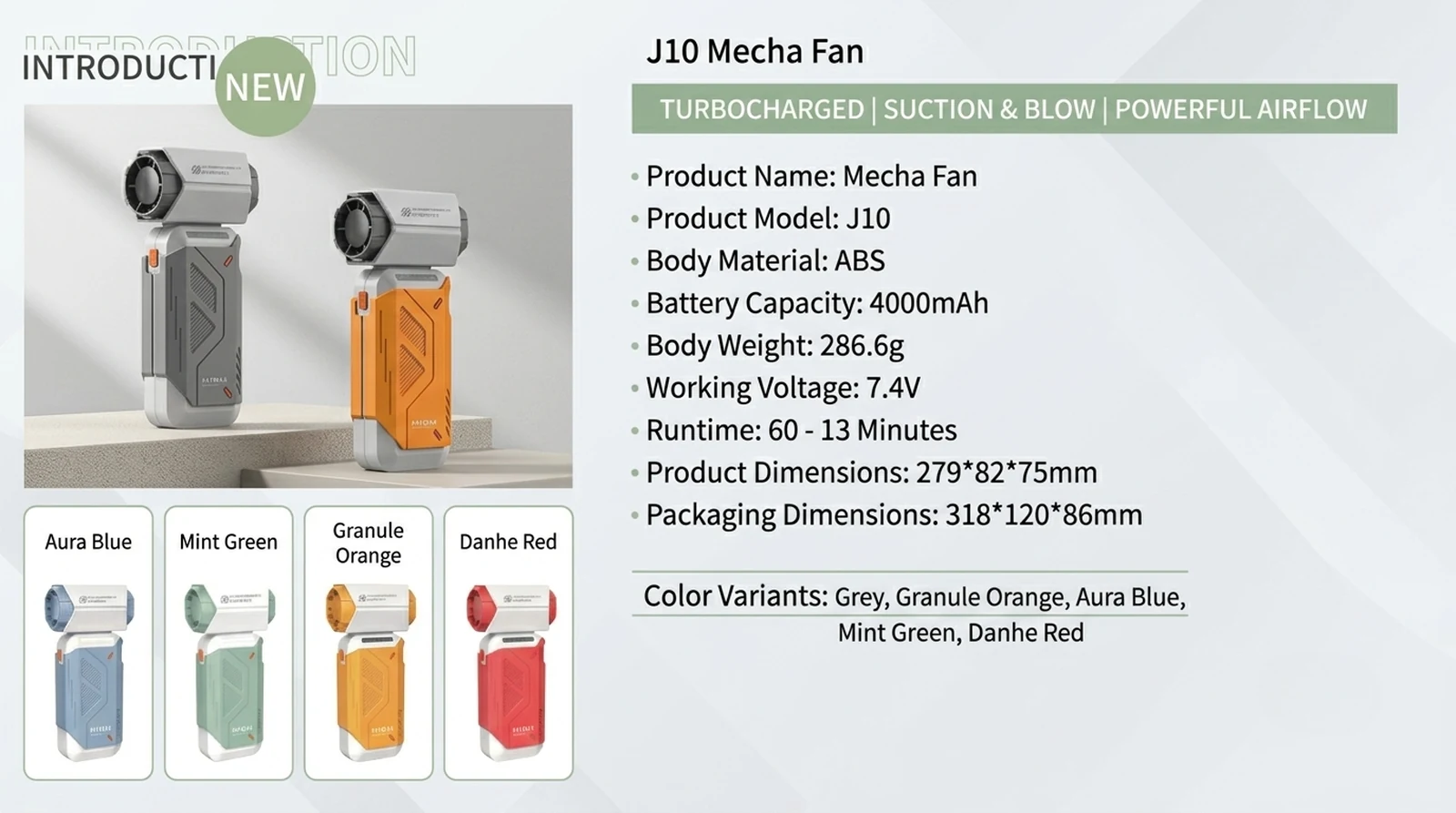
To make the framework concrete, consider how it applies to a specific category entrant — a portable mecha-style fan aimed at the outdoor and on-set crowd. The aesthetic alone, with exposed structural ribs and a deliberately industrial silhouette, is exactly the kind of product where catalog photography is most misleading.
A serious evaluation of a product like the [J10 Mecha Fan](https://jlhy.cc/products/j10-mecha-fan/) would push past the visual language and into the substance: requesting a sample to verify airflow at each speed, listening for tonal noise rather than just loudness, inspecting the housing tolerances where the mecha-style ribs meet the body shell, asking for the motor and BMS documentation behind the runtime claims, and confirming which compliance marks apply to the actual SKU being quoted. Only after those steps does the catalog photo start to function as a useful summary rather than a substitute for evidence.

FAQ
**How long does a thorough portable fan supplier comparison take?**
For a serious shortlist of three to five suppliers, allow at least four to six weeks if sample shipping is involved. Documentation review and engineering interviews can run in parallel with sample transit to compress the timeline.
**What is the single most important thing to verify beyond the catalog photo?**
Battery documentation. The cell manufacturer, the BMS design, and the UN 38.3 status together determine whether the product can be shipped, sold, and serviced safely. Misrepresentation in this category is also the most common source of supplier disputes.
**Should I always visit the factory in person?**
Not always, but a first-time engagement with a new supplier of any significant volume is much stronger with a factory visit, either personally or through a trusted third-party inspector. Repeat orders with a known supplier can often be managed through remote audit channels, periodic video tours, and batch inspection reports.
**How do I tell whether an engineering team is real or just inherited from an OEM partner?**
Ask the supplier to walk you through a recent design change they made on their own authority, with engineering rationale. A genuine in-house team will describe trade-offs, failed iterations, and specific tool revisions. A reseller or trading company will deflect to the upstream factory.
**Is a higher unit price ever justified by engineering depth?**
Buyers evaluating engineering depth are typically looking for reduced warranty exposure, longer product lifecycles, and a partner who can support future revisions. Whether those benefits justify a different pricing tier is a commercial decision, but it should be evaluated against total cost of ownership rather than unit cost alone. Request quotes with full specification parity before making the comparison.
Frequently Asked Questions
How long does a thorough portable fan supplier comparison take?
For a serious shortlist of three to five suppliers, allow at least four to six weeks if sample shipping is involved. Documentation review and engineering interviews can run in parallel with sample transit to compress the overall timeline.
What is the single most important thing to verify beyond the catalog photo?
Battery documentation. The cell manufacturer, the BMS design, and the UN 38.3 transport status together determine whether the product can be shipped, sold, and serviced safely, and misrepresentation in this category is the most common source of supplier disputes.
Should I always visit the factory in person?
Not always, but a first-time engagement with a new supplier of any significant volume is much stronger with a factory visit, either personally or through a trusted third-party inspector. Repeat orders with a known supplier can often be managed through remote audit channels, periodic video tours, and batch inspection reports.
How do I tell whether an engineering team is real or inherited from an OEM partner?
Ask the supplier to walk you through a recent design change they made on their own authority, with engineering rationale. A genuine in-house team will describe trade-offs, failed iterations, and specific tool revisions. A reseller or trading company will typically deflect to the upstream factory.
Is a higher price tier ever justified by engineering depth?
Buyers evaluating engineering depth are typically looking for reduced warranty exposure, longer product lifecycles, and a partner who can support future revisions. Whether those benefits justify a different pricing tier is a commercial decision, but it should be evaluated against total cost of ownership rather than unit cost alone. Always request quotes with full specification parity before making the comparison.