A Practical Factory Audit Checklist for Small Importers
Running a small import business does not mean skipping due diligence. This practical factory audit checklist walks importers through what they can reasonably verify before placing an order, including remote options and inspection strategy.
A Practical Factory Audit Checklist for Small Importers

Running a small import business is a high-wire act. You need quality products, reliable lead times, and trustworthy suppliers, but you rarely have the budget for a dedicated sourcing team or the time to fly across the world for a multi-day factory tour. Yet the stakes are real: a bad supplier decision can tie up working capital, miss your sales window, and damage relationships with downstream retailers.
A structured factory audit process is the bridge between trust and verification. The good news is that modern importers can accomplish a great deal of due diligence remotely, supplemented by targeted on-site visits when the volume justifies it. Below is a practical checklist that small importers can actually execute — not a corporate-procurement whitepaper.
What a Small Importer Can Reasonably Verify Before Ordering
You do not need to become a quality engineer, but you do need to verify the basics. The first goal of any pre-order audit is to confirm that the supplier is who they claim to be and that they have the operational capacity to deliver your order on the agreed terms.
A reasonable scope for a small importer covers five overlapping layers:
- **Business legitimacy**: Verify the company is legally registered, has a real office or factory address, and operates the basic financial rails (business bank account, tax registration where applicable).
- **Production capacity**: Confirm the facility actually runs the production steps relevant to your product. A factory assembling consumer electronics is not automatically qualified to assemble portable fans or mechanical enclosures.
- **Quality management system**: Look for an active, documented process — not a wall plaque. Ask how non-conforming materials are handled, how production batches are tracked, and what corrective-action documentation looks like.
- **Compliance posture**: Determine whether the factory holds the certifications your destination market requires. The same batteries, plastics, or electrical components may need different approvals depending on where the goods are sold.
- **Communication and documentation maturity**: A factory that responds to RFQs slowly or sends inconsistent export documents before the first order will be much harder to deal with during a customs hold.
Document each layer with screenshots, file copies, and dated notes. If anything changes between the audit and the first purchase order, you have a baseline to compare against.
Remote Audit Options for Distant Buyers
For most small importers, the first round of audit work happens entirely online. The goal of a remote audit is not to replace the eyes-on walkthrough — it is to filter out mismatched suppliers before you spend money on a trip.
A reliable remote audit typically combines:
- **Video facility walkthrough**: Ask the supplier to record or live-stream a tour that covers the front gate, the production floor, the warehouse, the QC station, and the packaging area. Insist on continuous, unedited footage. Short clips of curated workstations are a soft red flag.
- **Live interviews with key staff**: Speak with the sales manager, the production supervisor, and (if possible) the QC lead. Their language proficiency, technical fluency, and willingness to answer unscripted questions tell you a great deal about how the factory actually communicates internally.
- **Geotagged photos and timestamps**: A morning exterior shot of the building, a rooftop view of the surrounding neighborhood, and dated photos of the loading dock are harder to fake than polished marketing images. Cross-check image metadata where the supplier is willing to share original files.
- **Document sharing via secure folders**: Use a shared cloud drive rather than email attachments. Version control on certificates, audit reports, and sample approvals becomes much easier.
- **References from comparable buyers**: Ask for two or three existing customers of similar size and product category. A brief call can reveal recurring problems the supplier's sales team would prefer you did not hear about.
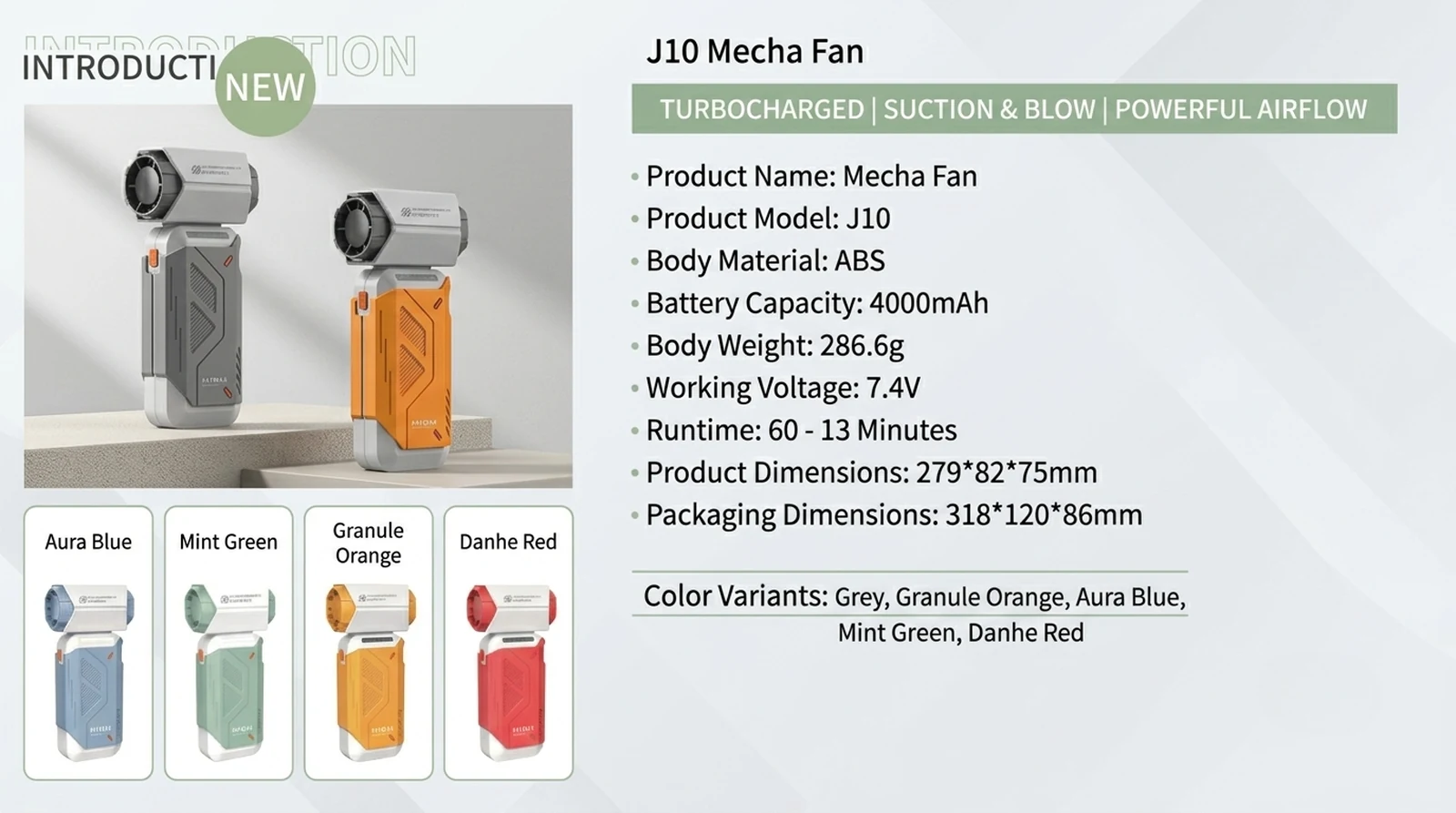
Where the supplier already publishes technical documentation, certification lists, and product data sheets online, importers can move even faster. For example, the product literature for the J10 Mecha Fan is published with downloadable spec sheets and compliance notes that buyers can review before opening a chat window — a useful benchmark for how mature suppliers should present documentation in advance.
Documentation to Request During Supplier Evaluation
Documentation is the cheapest part of an audit and the easiest to verify. Insist on seeing the originals, not descriptions. The following documents should be on your request list:
- **Business license** and any subsidiary registrations relevant to your product category.
- **Export license**, if the destination market requires specific export approvals.
- **ISO 9001 certificate** (or other QMS standard) issued by an accredited body, plus the certificate number so you can validate it directly with the issuing registrar.
- **Product-specific certifications**: CE, FCC, RoHS, REACH, UKCA, PSE, KC, BIS, CCC, or others as required by your market. These should list the specific model numbers covered, not just the factory name.
- **Test reports from accredited third-party labs** for materials, electrical safety, drop tests, vibration, IP rating, or any other claim made on the product page.
- **Material declarations and SDS sheets** for batteries, chemicals, coatings, or textiles.
- **Capacity statement**: number of production lines, monthly output, headcount, and shifts. A rough floor plan or production flow diagram is a bonus.
- **Past export records** such as bills of lading or commercial invoices to comparable markets, with sensitive details redacted where appropriate.
- **Sample inspection reports** from the supplier's internal QC, including AQL levels used for both raw material and finished goods inspection.
- **Trade references** with permission to contact two or three overseas buyers.
Keep in mind that anyone can display a certificate image on a website. Always validate the issuing body, the certificate number, and the validity period. Many accreditation bodies maintain searchable online registers; use them.
The Role of Third-Party Inspection Services
Even a sharp importer cannot personally inspect every shipment. That is why the third-party inspection industry exists: independent QC firms send trained inspectors to the factory, observe the production run against your specification sheet, and issue a report you can act on.
For small importers, the most common inspection patterns are:
- **Pre-production inspection (PPI)**: Verifies that raw materials, components, and sub-assemblies match the order before manufacturing begins. Especially valuable for customized or first-time runs.
- **During-production inspection (DUPRO)**: Conducted when roughly 20 to 40 percent of the order is complete. A solid middle option that catches defects early without the cost of two full inspections.
- **Pre-shipment inspection (PSI)**: The most common form. Inspectors check a random sample drawn using an AQL table against your specification, perform functional tests, and document packaging and labeling.
- **Container loading check (CLC)**: Verifies that the right quantity is loaded, the cartons are properly packed, and the container is clean and sealed correctly before it leaves the factory gate.
The single best use of a third-party inspector is when your destination market has strict compliance enforcement. A failed shipment at the port of entry is far more expensive than a paid inspection. The cost of inspection is best understood as insurance on the order, not as an add-on expense.
When selecting an inspection partner, prefer firms that publish their inspector training requirements, are accredited to ISO 17020, and are willing to share redacted sample reports. Avoid firms that quote only on turnaround time without asking for your specification sheet — they will often produce generic reports that do not address your actual risk surface.
Red Flags and Warning Signals During Audit
A factory audit is also a search for what is missing. The most damaging supplier failures are rarely announced in advance, but they leave a trail of small inconsistencies. Train yourself to recognize:
- **Reluctance to share documentation**: A legitimate factory will not hide its business license or quality certificates. Excessive secrecy around capacity numbers, headcount, or client references is a soft warning.
- **Constant name or address changes**: Frequent updates to the company name, the registered address, or the contact details on documentation can indicate shell-company behavior.
- **Pressure to skip samples**: Any factory that pushes you to skip pre-production samples on a customized product is absorbing risk that will surface later in your first production run.
- **Unverifiable certification numbers**: If a certificate's details cannot be checked with the issuing body, treat the document as a marketing image rather than evidence of compliance.
- **Inconsistent product knowledge**: A sales contact who cannot explain basic technical details, or who contradicts the answers given by the production supervisor, is a sign of poor internal coordination.
- **No formal sampling or AQL policy**: Factories that inspect everything manually with no statistical plan tend to ship inconsistent quality across the run.
- **Refusal of third-party inspections**: A supplier that allows only its own QC team to issue inspection reports is signaling that it does not want independent verification.
- **Misaligned payment terms**: Standard exporter terms involve a deposit against a confirmed purchase order and a balance against shipping documents. Any structure that asks for an unusually large upfront payment on the first order should be a pause, not a panic, but it should be a pause.
None of these signals is a verdict on its own. Together they form a pattern, and that pattern is what you are evaluating.
Building a Repeatable Audit Workflow
The biggest advantage a small importer can build over the long term is process. A repeatable audit workflow turns each new supplier evaluation into a comparable record. The simplest version looks like this:
1. **Triage**: Compile a shortlist of two to four suppliers that meet your baseline cost, MOQ, and lead-time filters.
2. **Remote verification**: Run the documentation, video, and reference checks described above.
3. **Sampling**: Commission samples from the top two candidates using identical specifications.
4. **Pilot inspection**: Order a small first batch — ideally under 10 percent of your forecasted annual volume — and run a pre-shipment inspection.
5. **Review and scale**: Use the inspection report, the shipment experience, and the post-delivery defect rate as the data points for the next order decision.
Over five to ten supplier relationships, this workflow produces an internal scorecard that becomes more accurate every cycle. It also creates a paper trail you can hand to a freight forwarder, a bank issuing a letter of credit, or a downstream retail partner asking how you qualify your supply chain.
For importers who want a worked example of how suppliers can structure their public factory and product documentation, the [J10 Mecha Fan](https://jlhy.cc/products/j10-mecha-fan/) page at jlhy.cc shows the kind of spec sheets, certification notes, and order-flow content that professional vendors now publish as a baseline.
Final Thoughts
Factory auditing is not a single event but a recurring practice. The importers who consistently ship good product to retail are not the ones who found a "perfect" factory — they are the ones who built a disciplined verification routine and stuck to it. With the documentation, video tools, and third-party services available today, even a two-person import business can run a credible audit program. The checklist above is a starting framework. Tailor it to your product category, your destination market, and your risk tolerance, and revisit it once a quarter.


FAQ
**How long does a typical factory audit take for a small importer?**
A focused remote audit can be completed in five to ten business days once a supplier begins sharing documentation. Adding a third-party pre-shipment inspection on the pilot order usually adds another week after production is complete.
**Can a remote audit really replace an on-site visit?**
For a first order, a remote audit combined with samples and a third-party pre-shipment inspection is sufficient for most small importers. An on-site visit becomes valuable once the relationship matures and order volumes justify the travel cost.
**When should a small importer hire a third-party inspector instead of doing it in-house?**
As soon as the order value exceeds the importer's financial comfort zone for absorbing a rejected shipment at the destination port. For most small importers this threshold is reached on the very first production order.
Frequently Asked Questions
How long does a typical factory audit take for a small importer?
A focused remote audit can be completed in five to ten business days once a supplier begins sharing documentation. Adding a third-party pre-shipment inspection on the pilot order usually adds another week after production is complete.
Can a remote audit really replace an on-site visit?
For a first order, a remote audit combined with samples and a third-party pre-shipment inspection is sufficient for most small importers. An on-site visit becomes valuable once the relationship matures and order volumes justify the travel cost.
When should a small importer hire a third-party inspector instead of doing it in-house?
As soon as the order value exceeds the importer's financial comfort zone for absorbing a rejected shipment at the destination port. For most small importers this threshold is reached on the very first production order.