What Ultra-Thin Means in Menstrual Heating Belt Design — B2B Sourcing Guide

In personal care appliances, the term "ultra-thin" gets used loosely across retail listings, but in OEM/ODM development it carries specific engineering meaning. For menstrual heating belts, thinness is not just a marketing angle — it shapes the wearer's comfort, the battery architecture, and the entire production workflow. B2B importers sourcing from Chinese factories need to look past the marketing copy and understand what ultra-thin actually delivers at the component level.
What "Ultra-Thin" Actually Means in Heating Belt Design
In OEM/ODM product development, the word "ultra-thin" refers to a measurable engineering threshold rather than a vague lifestyle claim. For menstrual heating belts, ultra-thin typically means the entire device thickness — including battery, heating film, outer shell, and any PCB control components — measures 6mm or less at its thickest cross-section. Anything thicker than roughly 8mm starts to feel bulky under fitted clothing, while sub-6mm profiles allow the belt to lay flat against the lower abdomen with minimal visible outline. Importers evaluating supplier samples should request the cross-section drawing before committing to volume orders, because vendor claims of "ultra-thin" often refer only to the heating film layer rather than the assembled device. This distinction matters at retail, where end users quickly compare product depth against competitor units and post negative reviews when the belt feels heavier than advertised.
The Sub-6mm Thickness Benchmark
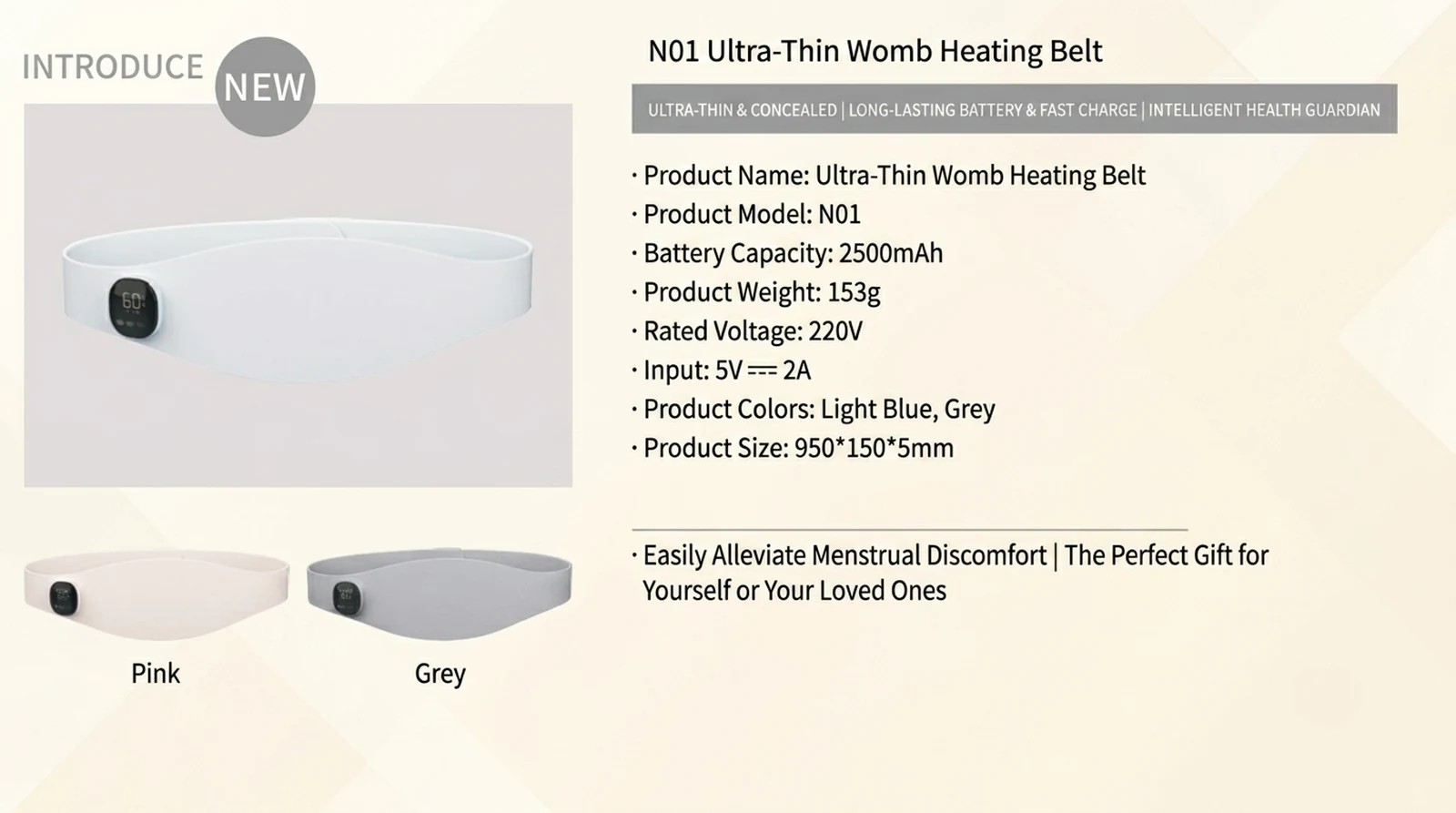
The 5mm to 6mm thickness range has become the practical benchmark for ultra-thin menstrual heating belts shipping into Europe and North America. Below this band, the device becomes genuinely wearable for office, travel, and sleep scenarios. Above 8mm, the belt shifts into "heating pad" territory rather than "wearable comfort device" — a category downgrade that affects retail positioning. At factories like XMT in Dongguan, the typical ultra-thin profile sits around 5mm total thickness, balancing battery capacity against wearability. The next benchmark to track is weight: a 153g belt versus a 250g belt represents a substantial difference in long-duration comfort. B2B buyers comparing samples from multiple Chinese suppliers should weigh and measure every prototype identically, because spec sheets frequently list the heating film thickness alone. Asking for a full cross-section diagram with battery height, shell thickness, and edge radius provides a more honest comparison than catalog descriptions.
Materials and Layer Stack Engineering
Achieving ultra-thin profiles requires careful selection of every layer in the device stack. The outer shell is typically a soft-touch TPU or silicone-coated fabric that bonds directly to a polyimide or carbon-film heating element. Underneath sits a thin lithium-polymer battery cell, usually 2500mAh or smaller, with a custom-shaped form factor rather than a standard rectangular pouch. A bare PCB with minimal component height — often a single-sided board with low-profile MOSFETs — drives the temperature regulation. The bonding between layers uses medical-grade adhesive films that remain flexible after curing, since rigid bonding compounds crack under repeated bending. Each layer shave saves roughly 0.3mm to 0.5mm, but stacks add up quickly: an unoptimized design can easily exceed 10mm while a properly engineered stack stays under 6mm. This is why factory-direct OEM/ODM partners with in-house stack-up expertise tend to deliver slimmer units than trading companies assembling components from separate vendors.
Battery Capacity Trade-offs in Slim Profiles
Battery capacity is the most visible trade-off when chasing thinner profiles. A standard 5000mAh cylindrical cell adds bulk that defeats the ultra-thin goal, so designers pivot to flat lithium-polymer cells in custom footprints. A 2500mAh cell at 3.7V can run a typical 40°C heating cycle for around 90 minutes before needing a recharge — enough for a workday use case but not a full overnight session. Importers who want longer runtime must either accept thicker profiles (8mm+) or specify larger battery footprints that wrap around the waist. Some OEMs now offer dual-cell designs where two thinner cells sit side-by-side, distributing weight without increasing peak thickness. The decision between runtime, weight, and profile depth should be made before tooling begins, because changing battery dimensions mid-development forces new tooling for the battery bay and outer shell. Spec sheets should clarify whether runtime is measured at maximum heat, mid heat, or alternating cycles.
Comfort, Discretion, and Real-World Wearability
End users wear menstrual heating belts against the lower abdomen for hours at a time, often under fitted knitwear or work uniforms. A 153g ultra-thin belt at 5mm thickness effectively disappears under most clothing, while a 250g device at 8mm creates a visible bulge and pulls at the waistband during movement. Comfort during prolonged wear depends on three factors: profile depth, edge radius, and weight distribution across the contact patch. Sharp edges dig into the skin when seated; rounded edges press uniformly. B2B buyers should test samples in real wear scenarios — sitting, walking, bending — rather than relying on bench measurements alone. Consumer reviews for this category consistently flag "feels heavy" and "visible through shirt" as top complaints, both of which trace back to thickness and weight specifications. Sample units that pass the seated-bend test usually perform well in retail.
Thermal Performance at Reduced Thickness
Heat distribution becomes harder to control as the heating film gets thinner. A 0.3mm polyimide heater spreads warmth more evenly than a 1.0mm silicone wire heater, but it also loses heat to ambient air faster because there is less insulation between the heating element and the outer shell. Engineers compensate by adding a thin reflective backing layer that redirects infrared radiation back toward the body, rather than letting it dissipate outward. Without this backing layer, an ultra-thin belt can feel cooler than its rated temperature despite drawing the same current. Sample testing should always include a thermal imaging check at multiple body-contact points — a 5°C variance across the contact patch indicates poor heat spread. Suppliers serious about ultra-thin design will provide thermal mapping data with sample shipments; trading companies and small workshops typically cannot.
Manufacturing and Assembly Complexity
Manufacturing ultra-thin heating belts is more labor-intensive than building standard heating pads. Each layer must be precisely aligned during lamination, because a 1mm shift between the battery bay and the outer shell cutout creates a visible bump. Adhesive curing happens under controlled pressure to avoid air pockets, which later become hot spots or peeling points. Yield rates for ultra-thin builds typically run 5 to 10 percentage points lower than thicker models, which affects per-unit production cost even though specific pricing decisions are not part of this guide. Factories with automated lamination presses handle this better than workshops using manual roller systems. B2B importers placing first-time orders should request a pilot run of 50 to 100 units before full production — a standard precaution in OEM/ODM workflows that catches alignment and bonding defects early.
Quality Control for Flexible Thin Electronics
Quality control for thin flexible electronics requires different test protocols than standard personal care appliances. Each unit should pass a bend-cycle test of at least 5,000 repetitions to simulate months of daily wear, with resistance measurements taken before and after. Battery cells need individual capacity verification — not batch sampling — because thin LiPo cells show higher variance than cylindrical cells. Surface insulation testing confirms no current leakage at the edges, where the heating film meets the shell. Most reputable OEM/ODM factories run a four-stage QC process: incoming component inspection, in-process lamination checks, finished-unit electrical test, and a final cosmetic scan. Importers auditing potential suppliers should ask to see the bend-test rig and the battery capacity data logger, not just the final packaging line. A factory that documents these tests has typically invested in process control, which translates into fewer return-rate headaches downstream.
MOQ, Lead Time, and Sourcing Strategy
From a sourcing perspective, ultra-thin heating belts fit comfortably within standard OEM/ODM MOQ tiers, often starting at 500 units for stock configurations and 1000 units for custom shell colors or printed branding. Lead times run longer than thicker products because the lamination stage adds roughly 7 to 10 days to the schedule. Custom tooling for the battery bay and outer shell can extend first-article timelines, but reorders ship faster once tooling is validated. Capacity at mid-size Dongguan factories generally supports 150,000+ units per month across the full personal care appliance range, so ultra-thin belt orders rarely face allocation issues. For B2B buyers evaluating whether ultra-thin is worth the engineering trade-offs, the strongest signal is end-user feedback in target markets — retail reviews in Europe and North America consistently rank thickness as a top-three purchase driver. Importers who plan to expand their personal care appliance line should evaluate ultra-thin belt production early, since the supplier qualification process for thin-flexible-electronics factories overlaps with the qualification process for adjacent categories like high-speed hair dryers and wearable fans.
Related Articles
For deeper context on flexible-electronics sourcing, see our guide to OEM/ODM personal care appliance quality control. Importers comparing ultra-thin heating belts against other wearable personal care categories can also review our breakdown of mecha fan specifications and factory sourcing to understand how thin-form-factor engineering principles apply across adjacent product lines.
Frequently Asked Questions
What thickness qualifies as "ultra-thin" for a menstrual heating belt?
In OEM/ODM development, ultra-thin typically means the full assembled device measures 6mm or less at its thickest cross-section, including battery, heating element, and outer shell. Anything above 8mm shifts the product into heating-pad territory rather than wearable comfort-device territory.
How does ultra-thin design affect battery life?
Slim profiles require flat lithium-polymer cells in custom footprints, which trade total capacity for thinner construction. A typical 2500mAh ultra-thin belt runs around 90 minutes at maximum heat — enough for workday use, but importers wanting longer runtime must either accept thicker profiles or specify dual-cell designs.
What MOQ should importers expect for custom ultra-thin heating belts?
Standard OEM/ODM MOQs start at 500 units for stock configurations and 1000 units for custom colors or branding. Lead times run roughly 7 to 10 days longer than thicker products due to the lamination stage, and first-article tooling for custom battery bays typically extends initial timelines further.