Fast-Charging Heating Belts and Distributor Inventory Risk
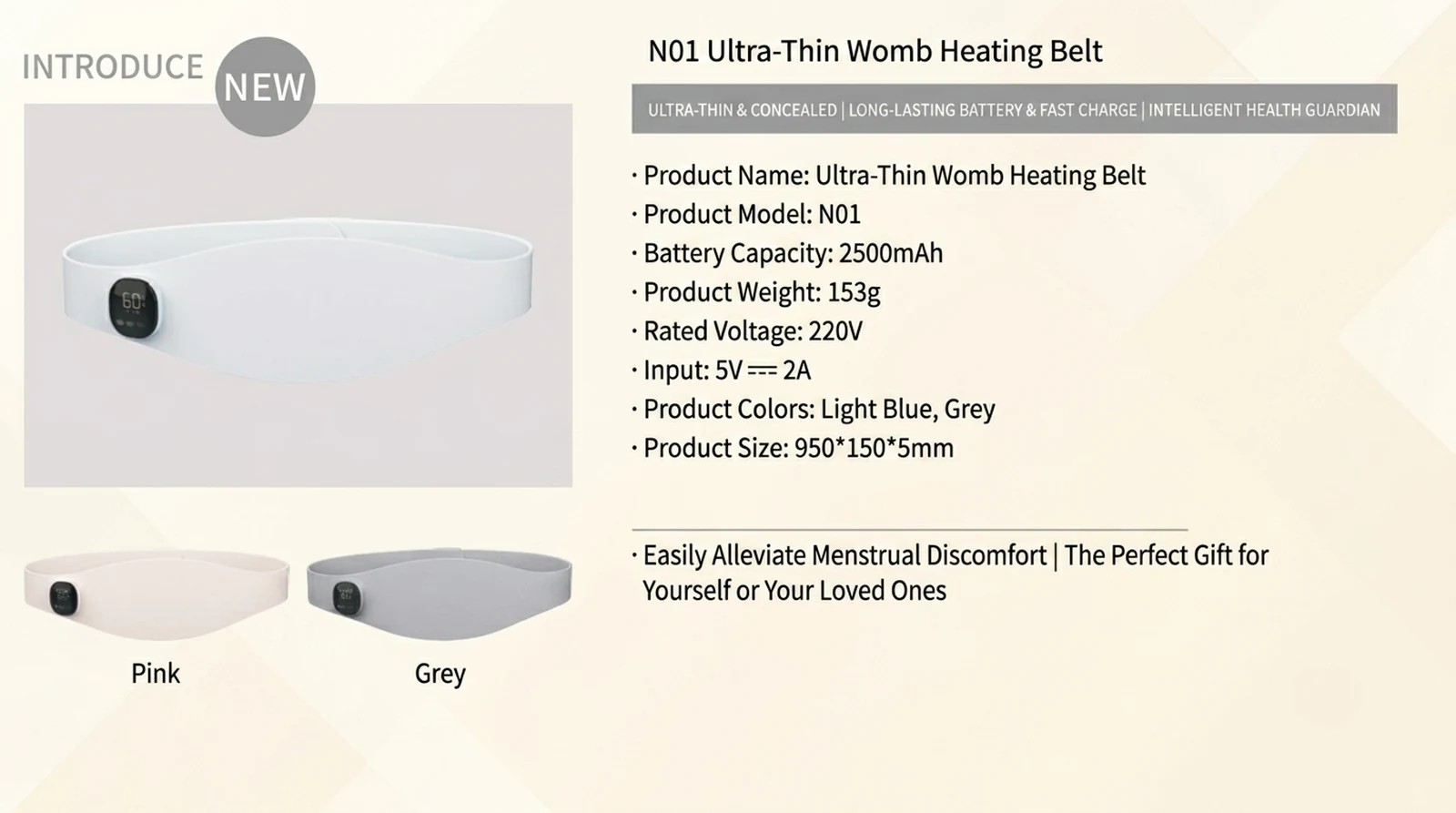

For distributors of personal care wellness products, battery charging speed has quietly become one of the most decisive specs in inventory planning. A heating belt that reaches full charge in under two hours behaves very differently on a shelf, in a warehouse, and in transit compared to a unit that needs eight or ten hours plugged in. The operational implications cascade into ordering cycles, safety stock levels, and working capital exposure in ways that traditional forecasting models rarely capture. Distributors who recognize this often reweight their sourcing criteria long before their competitors do.
Why Charging Time Matters More Than Capacity for Distributors
Battery capacity — measured in mAh — dominates the marketing copy, but for distributors the time-to-full-charge figure often determines whether a SKU earns or burns money. A 2500mAh pack that recharges in roughly 90 minutes supports daily consumer use without an overnight wait, which means end-users stay loyal to the product rather than abandoning it for a faster alternative. Distributors reading inbound feedback from retailers quickly learn that slow-charge complaints cluster around repeat purchase decisions, not first-time trials.
When a heating belt charges quickly, the after-sales support burden on the distributor also drops. Battery-related returns tied to "didn't hold charge" or "took too long" claims often point back to user perception of charging speed rather than actual cell degradation. Sourcing a belt that genuinely charges in under two hours removes a whole category of avoidable support tickets that otherwise drain distributor margin.
From a logistics standpoint, faster charging means less time products sit in QC charging bays at the factory, less dwell time at consolidation warehouses, and faster turnaround for retail display demos. The cumulative effect trims days off the order-to-shelf pipeline, which directly improves time-to-revenue on every reorder cycle.
The Anatomy of Distributor Inventory Risk
Inventory risk for a wellness distributor is rarely about running out of stock on a single SKU. It is the compound probability of overstock, obsolescence, dead capital, and demand miss-read across an entire product portfolio. Heating belts with extended charging times amplify each of these failure modes because slow-charge models sell slowly, sit longer on shelves, and age faster relative to competitor units that match modern consumer habits.
The classic risk categories — obsolete stock write-downs, working capital tied up in slow movers, and the markdown pressure that follows — all intensify when a product's core value proposition (portable, on-demand heat) is undermined by a charging bottleneck. Distributors sometimes absorb these costs for an entire season before recognizing that the SKU is structurally underperforming rather than just seasonally soft.
A practical exercise for any distributor is to map current inventory by "days of cover" at expected sell-through. SKUs with more than 120 days of cover are flagging inventory risk regardless of MSRP or category positioning. Heating belts that charge in under two hours consistently clear this threshold within 60 to 90 days when properly merchandised and supported by reasonable reorder lead times from the OEM partner.
Turnover Velocity and Capital Recycling
Fast-charging heating belts enable shorter cash conversion cycles. When a distributor places a replenishment order and receives, inspects, and ships stock to retailers within a 30-day window, the working capital invested in that batch is recovered and available for the next SKU decision. Slow-charge units extend that window to 60-90 days, tying up capital in inventory that cannot be redeployed for trend-driven opportunities that emerge mid-season.
This matters because the personal care category rewards agility. New colorways, seasonal collaborations, and limited-edition wellness campaigns can spike demand within weeks of announcement. Distributors whose working capital is locked in slow-moving heating belts cannot respond to those opportunities, while distributors carrying fast-charge inventory already operate on a rolling 30-day reinvestment rhythm.
For European and North American distributors specifically, the working capital cost differential between a 30-day and 90-day cycle can be the difference between expanding into a second retail channel and standing still. Inventory velocity, not absolute volume, becomes the strategic lever that compounds across multiple selling seasons.
Reducing Safety Stock Without Raising Stockout Probability
Safety stock exists to buffer against demand variability and supplier lead time uncertainty. For heating belts, fast charging reduces safety stock needs in two indirect ways. First, it lifts the average weekly sell-through, which lowers the coefficient of variation in demand and shrinks the statistical buffer required at the distribution hub. Second, it improves retailer reorder confidence, which shortens the order-to-reorder gap and lets the distributor run leaner without sacrificing shelf availability.
A distributor carrying a fast-charge heating belt at a typical safety stock factor of 1.5x weekly demand can often reduce that to 1.2x without raising stockout risk. Over a year across a multi-market distribution footprint, the freed-up shelf space and capital can fund an additional SKU launch or a regional expansion that would otherwise require fresh financing.
This calculation depends on consistent factory supply, which is where OEM/ODM partners with proven monthly throughput become strategic rather than transactional. For more on supplier qualification, see our guide on evaluating OEM/ODM partners.
Seasonal Demand and the Fast-Charge Moat
Menstrual heating belts and wellness thermal wearables spike during autumn and winter in temperate markets, with secondary peaks around back-to-school and New Year wellness campaigns. Slow-charge units purchased as seasonal stock often arrive too late to capitalize on the peak because they were ordered based on a 90-day recharge assumption rather than the actual consumer usage pattern observed at retail.
A 90-minute full-charge heating belt lets a retailer reorder mid-season and still receive usable inventory within the campaign window. This effectively gives distributors two selling seasons per SKU per year instead of one — the original launch and a mid-season replenishment. Few operational advantages compound as cleanly as this across multiple annual cycles.
For distributors selling across both hemispheres, the seasonal offset is even more powerful. A single production batch can be split between northern and southern hemisphere retail calendars with fast-charge confidence, instead of being held in bonded warehouses until the next annual cycle. This roughly halves the carrying cost per unit over its useful shelf life.
Returns, Shelf-Life, and Battery Health Considerations
Lithium-ion cells degrade whether they are used or not. Heating belts sitting in a warehouse for six months before sale arrive at retail with measurably less capacity than units sold within 60 days of manufacture. Fast-charge inventory turns faster, which means products reach end-users closer to their date of manufacture and within their prime performance window.
Distributors should request cell date codes from their OEM partner and factor them into inventory acceptance criteria. A batch with cells older than 90 days at the time of delivery is functionally a different product from a batch with cells under 60 days, even if both pass incoming QC. Documenting this on each shipment protects both parties and creates a paper trail for any downstream warranty discussion.
Returns and warranty exposure also drop when the underlying product matches end-user expectations. A user who charges the belt once and finds it ready for travel within 90 minutes is a different satisfaction profile from one who plugs in overnight for the third consecutive day. The latter generates complaints and refunds; the former generates referrals and repeat purchases.
MOQ Flexibility and Small-Batch Replenishment
The economics of fast-charge inventory depend on the ability to reorder in modest quantities. A distributor who can place a 500-unit reorder for a proven SKU has very different exposure than one locked into 2,000-unit MOQ cycles. Smaller batches turn faster, test new colorways more cheaply, and reduce the markdown risk if a particular variant underperforms against the rest of the range.
OEM/ODM factories that support MOQ 500 or 1000 for heating belts, with 4-stage QC and documented R&D iteration cycles, give distributors the operational agility to match fast-charge inventory behavior. The factory's flexibility becomes the distributor's flexibility, and the two compound across seasons rather than canceling each other out.
At Xinmeili Technology, the N01 ultra-thin menstrual heating belt is designed for exactly this kind of lean replenishment cycle. With a 2500mAh pack weighing 153g and a 950 by 150 by 5mm profile, the platform supports distributors who want to test a region before committing to a full container load.
Customization and Regional Differentiation
Fast charging also unlocks a more nuanced customization strategy. When the base platform charges quickly, distributors can offer regional variations — color palettes, branding, packaging language, accessory kits — without worrying that the underlying product will underperform in market for reasons unrelated to the customization itself. A fast-charge baseline removes that confound entirely.
For European distributors, this means local-language packaging and EU-compliant documentation can be layered onto the same core heating belt. For North American distributors, color and accessory strategies can be tested without committing to a full rebranding cycle. The customization layer becomes additive rather than risky, which changes the conversation from "should we customize" to "what should we test first."
OEM/ODM partners who can absorb these regional specifications — CE, FCC, UKCA, RoHS, REACH documentation support — without extending lead times materially are the partners worth structuring multi-season inventory around. They become an extension of the distributor's merchandising team rather than a remote vendor.
Operational Checklist for Distributors Evaluating Heating Belt Inventory
Before signing the next purchase order, distributors should validate five concrete data points with their OEM partner. First, confirm the actual measured time-to-full-charge under typical ambient conditions, not just the marketing claim on the spec sheet. Second, request cell date codes on each shipment and agree on an acceptance threshold, ideally cells under 60 days at delivery. Third, confirm MOQ flexibility for replenishment cycles — 500 and 1000 unit options are the operational sweet spot for most mid-sized distributors running multi-region portfolios.
Fourth, ask for documented QC pass rates and defect categorization by batch over the last three production runs. Fifth, validate the supplier's monthly throughput and lead time stability across at least three recent orders, including any seasonal spikes the factory absorbed. For an end-to-end checklist on this kind of supplier qualification, see our supplier audit workflow.
Distributors who treat charging speed as a strategic inventory variable — rather than a marketing footnote — consistently outperform competitors stuck on slower, older platforms. As cell technology continues to compress charge times over the next product cycles, the operational floor for "acceptable" heating belt performance will keep rising, and the distributors who build their inventory models around that reality now will be the ones still expanding five years from now.
Related Articles
- Evaluating OEM/ODM partners for personal care sourcing
- MOQ negotiation in China sourcing
- Personal care import certifications
- Supplier audit workflow in China
Frequently Asked Questions
How does fast-charging technology actually reduce inventory risk for distributors?
Fast-charging heating belts turn faster because they match modern consumer usage patterns, which shortens days-of-cover, lowers safety stock requirements, and frees working capital for the next SKU decision. The compounding effect across multiple seasons is what turns a spec sheet number into a real inventory strategy.
What charging time threshold qualifies a heating belt as fast-charging?
For portable heating belts in the wellness category, anything under two hours to full charge from empty is generally considered fast-charging for consumer-grade devices. Premium models in the segment achieve 90 minutes or less, which meaningfully differentiates them at retail and reduces return rates.
How should distributors negotiate MOQ when sourcing fast-charge heating belts?
The negotiation should center on cell date codes, production batch flexibility, and documentation support for regional certifications rather than headline price. MOQ 500 to 1000 units per SKU is the operational sweet spot for distributors running lean, fast-turn inventory cycles tied to fast-charge sell-through.