How Importers Evaluate Turbocharged Portable Fan Samples in 2026
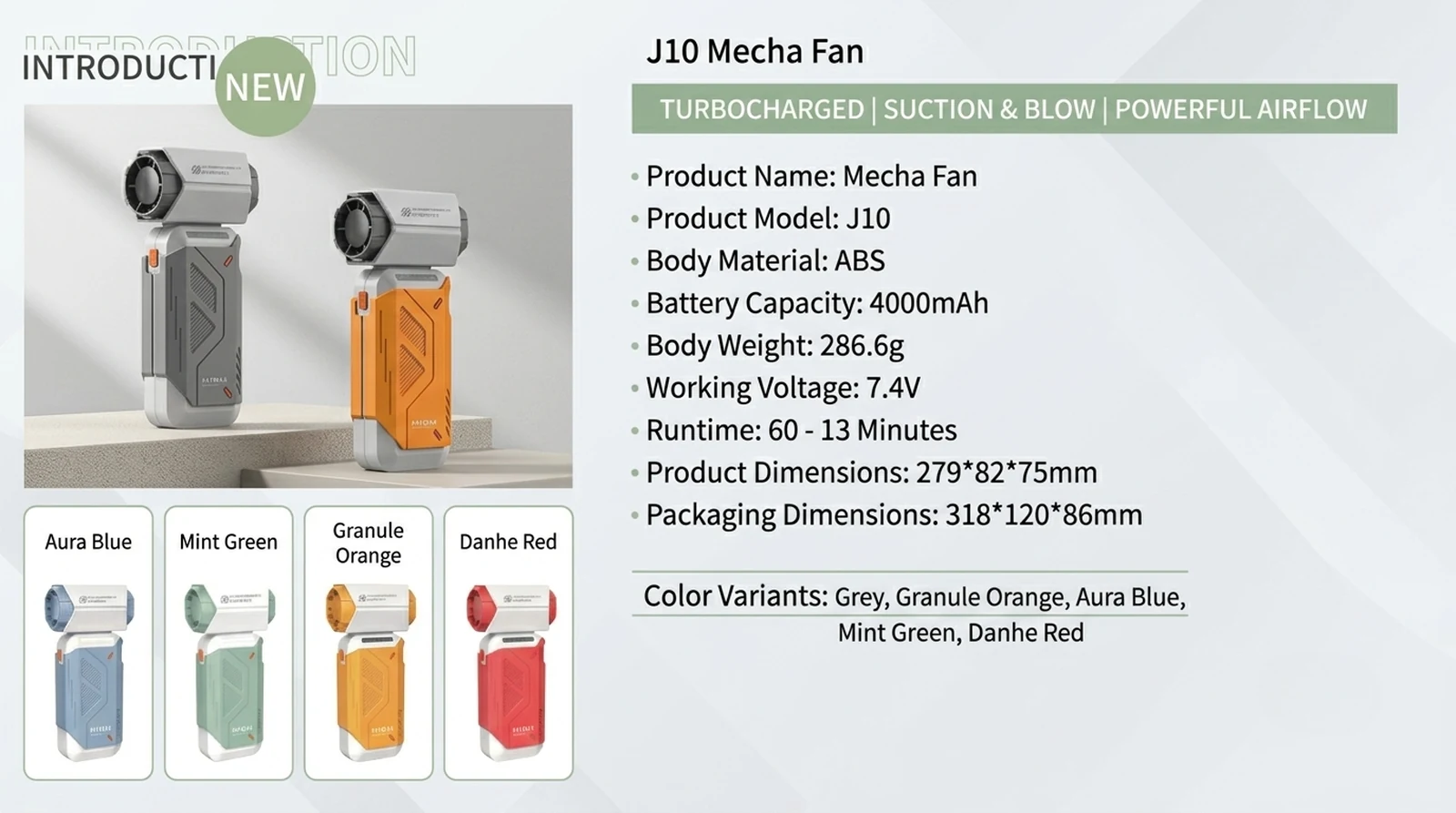

Sample evaluation is the single most leveraged decision an importer makes in a portable fan program. A rushed sample sign-off locks in tooling, packaging, and brand assumptions that are expensive to unwind mid-season. In 2026, with handheld turbo fans crowded by lookalike SKUs, the importers who win retail are the ones who treat the sample phase like a structured audit rather than a casual unboxing. This guide walks through the evaluation sequence an experienced buyer should run before releasing the first production PO.
Why 2026 Is a Reset Year for Portable Fan Sourcing
Three shifts are reshaping the handheld fan category this year. First, lithium cell supply has stabilized, meaning buyers can compare battery performance on a level playing field instead of hedging against shortage premiums. Second, retail buyers in Europe and North America are demanding clearer airflow data — vague "strong wind" claims no longer survive category manager review. Third, dual-use blow-and-suction designs have moved from novelty to expectation, particularly in outdoor and camping channels.
For an importer, that reset means the sample brief you wrote in 2023 is no longer fit for purpose. A 4000mAh battery, ABS body, and a brushless motor around the 286g class are now table stakes rather than differentiators. The conversation has shifted from "does it spin" to "can the factory prove repeatable performance across the whole production batch." Importers who enter 2026 sample cycles with updated checklists will catch defects before tooling is locked; importers who do not will absorb the rework cost.
Define What "Turbocharged" Actually Means in a Handheld Form Factor
Marketing language around turbo fans has drifted far from the engineering term. In a handheld context, "turbocharged" should be read as a high-RPM brushless motor paired with a ducted impeller designed to accelerate air through a constrained outlet. The relevant metrics are maximum wind speed (often quoted in m/s), sustained RPM under load, and the time-to-peak from cold start. A responsible factory should provide measured values for all three, not just a peak number from a lab-optimized prototype.
When reviewing samples, ask the supplier to disclose motor supplier, KV rating, and impeller geometry. A factory that cannot answer those questions is likely rebranding an off-the-shelf module rather than engineering a turbo unit. For dual-use blow/suction products like the J10 Mecha Fan form factor, the motor direction must also reverse cleanly without a noticeable lag, since a one-second pause between modes breaks the user experience. Treat turbo performance as a verified specification, not a label.
The First 48 Hours: Unboxing and Physical Inspection Protocols
A disciplined importer runs the same inspection sequence on every sample regardless of supplier relationship. Begin with packaging drop test simulation — five drops from 1.2 meters onto a hard surface — and inspect for housing cracks, button depression, and LED indicator function. Next, weigh the unit on a calibrated scale; a 286.6g target should land within ±3g on a sample run. Document any deviation, since plastic density shifts often predict mold wear in production.
Then move to surface finish. ABS shells should show consistent texture, no visible weld lines, and uniform color saturation. Pay particular attention to the impeller duct and grille alignment — a 1mm gap can drop perceived airflow by 8–10 percent. Photograph every finding, number each defect, and tag the supplier's QC stamp if visible. This 48-hour protocol becomes the benchmark your repeat-order QC team references on every incoming batch. See our [China fan factory audit checklist](/articles/china-fan-factory-audit-checklist-2026/) for the broader factory-side companion document.
Battery, Motor, and Thermal Performance Under Load
The 4000mAh cell is the heart of any modern handheld fan, but capacity on a label tells you nothing about sustained output. Run the sample on maximum speed until automatic cutoff, log the runtime, and compare it to the supplier's datasheet. Variance above 8 percent on a single sample is acceptable; variance above that across three units suggests cell binning issues that will surface in the field.
Thermal behavior is the more honest test. After 20 minutes of continuous turbo operation, the housing near the motor should remain under a temperature the user can comfortably grip. Excessive heat indicates either an undersized motor controller or insufficient thermal venting. Also check for RPM droop — fans that throttle aggressively under heat will get consumer returns. Run the sample in a 35°C chamber for a fuller picture if your test lab allows it.
Noise Testing: Decibel Ratings vs. Real-World Usability
Most factories will quote a noise figure in the 65–75 dB range measured at 1 meter. That number is only useful if the test methodology matches your retail buyer's expectation. Ask whether the dB reading was taken at idle, at half throttle, or at full turbo; the difference can be 15 dB or more. A 75 dB unit at peak is acceptable for outdoor use but disqualifies the product for office and bedside retail.
Run a simple subjective test in a quiet room with the sample at arm's length. Listen for high-frequency whistle, bearing rattle, and mode-switching clicks. These are the sounds consumers complain about in reviews even when the headline dB figure is reasonable. If you are targeting retail channels that prioritize noise sensitivity, also sample at 30cm distance — that is closer to how the product is actually used, and the perceived loudness doubles relative to a 1m lab measurement.
Material Choices and Build Quality for Retail-Ready Units
ABS remains the dominant shell material for handheld fans in this weight band, and for good reason: it is light, impact-resistant, and accepts a wide range of finishes. Verify that the supplier is using virgin ABS rather than regrind — regrind shows up as visible streaking under bright light and cracks earlier under drop stress. For 286g-class units, the right ABS grade makes the difference between a product that survives a year of daily use and one that returns at month four.
Examine the grille, button assembly, and Type-C port with a loupe. The grille should be a single molded piece or ultrasonically welded — glued grilles are a frequent failure point. Button travel should feel positive without being stiff, and the charging port should accept a standard cable without wobble. These are minor details individually, but together they form the perceived quality impression that drives consumer reviews.
Airflow Benchmarks and the "Blow vs. Suction" Dual-Use Question
Dual-use fans that blow and vacuum are no longer gimmicks. The camping, automotive, and outdoor enthusiast channels now expect this feature, and it materially expands the addressable retail footprint. When evaluating a dual-use sample, verify that mode-switching is reversible without a tool, that the suction nozzle forms a tight seal against flat surfaces, and that the dust-collection chamber (if any) empties cleanly.
Measure airflow in both directions if your test equipment allows. A unit optimized only for blowing will perform poorly in suction mode, with measurable pressure drop. A well-engineered dual-use design holds 70 percent or more of its peak performance in the secondary direction. For an importer sizing a 2026 program, that dual performance envelope is worth more than a single-direction headline wind-speed figure.
Certification Readiness: CE, FCC, UKCA, RoHS, REACH
A sample that looks great in your office is not retail-ready until it carries the right compliance marks for each destination market. For Europe, importers need CE, RoHS, and REACH; for the UK, UKCA; for North America, FCC. A responsible OEM partner should support the certification process end-to-end, sharing test reports from accredited labs and flagging any components that will require reformulation.
Treat the certification conversation as part of the sample phase, not after PO release. Ask the factory which labs they have used in the past 12 months and request copies of recent reports. A factory that has shipped similar products into the EU under its own paperwork is far easier to work with than one starting the certification clock from zero. Build this into your sample-evaluation scoring matrix so it is not an afterthought.
Sampling Logistics, MOQ 500, and Lead Time Realities
Most established factories in the Dongguan and Guangdong cluster run a sample-to-bulk lead time of 25–40 days once a sample is approved, with MOQs typically starting at 500 units for standard configurations and 1000 for customized shells or colorways. Capacity at the OEM partner you choose should comfortably absorb your reorder cadence — a partner running 150,000+ units per month with 15 R&D engineers and a 4-stage QC process is typically equipped to scale into multiple retail seasons.
During sample phase, track three timing metrics: sample build days, revision cycles, and bulk production scheduling. A clean sample process with one or two minor revisions is a leading indicator of a smooth bulk run. Three or more revision cycles, by contrast, signal communication gaps that will compound at scale. For a deeper look at the factory-side coordination that makes this work, see our [guide to OEM/ODM personal care appliance programs](https://jlhy.cc/articles/oem-odm-personal-care-appliances/).
From Approved Sample to Repeatable Bulk Orders
The final step in sample evaluation is not a signature — it is a documented handoff. Lock the approved sample in a sealed box with a golden-unit label. Require incoming inspection on every shipment to match against that golden unit, not against the supplier's own QC photos. This single habit has saved importers millions in chargebacks because it removes the ambiguity of what "approved" actually means six months into the program.
Looking forward, the importers who will win the 2026 handheld fan category are those who treat samples as the foundation of a multi-year supply relationship rather than a transactional checkpoint. A sample is a promise about how the next 50,000 units will behave — and only a structured, documented evaluation makes that promise enforceable across the production runs that follow.
Related Articles
For importers evaluating adjacent categories, our [guide to common B2B appliance sourcing mistakes](/articles/b2b-appliance-sourcing-mistakes/) walks through the missteps that show up across multiple product lines. If you are specifically focused on the J10 Mecha Fan form factor, the [J10 spec breakdown on the editorial site](https://j10fan.com/articles/j10-mecha-fan-spec-breakdown/) provides the engineering perspective behind the dual-use architecture.
Frequently Asked Questions
What airflow metrics should an importer request from a turbo fan sample?
Request measured peak wind speed in m/s, sustained RPM under load, and time-to-peak from cold start. Also ask for noise readings at 1 meter across the full speed range, and confirm that dual-use blow/suction performance holds 70 percent or more of peak in the secondary direction.
How long does a typical sample-to-bulk lead time run in 2026?
For OEM partners in the Guangdong cluster, sample-to-bulk lead time typically runs 25–40 days once a sample is approved. Sample builds themselves take 7–15 days depending on customization, with revision cycles averaging one to two rounds before bulk release.
Which certifications are mandatory for handheld fans sold into Europe and North America?
For Europe, importers need CE, RoHS, and REACH; for the UK, UKCA; for the United States and Canada, FCC. A factory with recent accredited lab reports for similar SKUs will move through certification significantly faster than one starting from scratch.