How to Build a Product Specification Sheet for OEM Appliances
A well-written specification sheet is the difference between a smooth OEM project and a costly one. Here is how to structure one that your factory and your team will both trust.
Why a Clear Specification Sheet Matters in OEM Appliance Projects

A specification sheet, sometimes called a product spec or a technical data sheet, is the single document that translates an idea into something a factory can engineer, source, and inspect. In OEM appliance projects, where dozens of stakeholders are involved (industrial designers, electrical engineers, tooling teams, regulatory advisors, QC staff, freight forwarders), the spec sheet is the shared vocabulary. When it is well written, it shrinks quote turnaround, reduces sampling rounds, and eliminates the silent assumptions that cause line stoppages.
The cost of a vague spec sheet, by contrast, is rarely visible at the start. It shows up later as mismatched samples, rejected shipments, or costly rework tooling. Teams that invest time in the spec document at project kickoff typically report fewer pre-production samples and faster time-to-market, because the factory is not forced to guess the buyer's intent.
A good specification sheet also serves as a legal anchor. Once buyer and manufacturer sign off on the same version, it defines what "conforming" means. If the delivered goods deviate from what was approved, the document supports claims, remedies, and corrective action plans. It should be treated as a living record, not a one-time email attachment.
Sections Every Spec Sheet Should Include
A specification sheet for an OEM appliance should be structured so that anyone reading it for the first time can find what they need without scrolling. The sections below are the de facto industry layout. You can rename them, but the content should be present.
1. Product Identification and Scope
Begin with identifiers: project code, model number, target markets, intended user, and the document's revision number with a date. A short product description (two or three sentences) helps downstream readers situate the item. If the spec is part of a product family that includes variants (sizes, colors, voltage versions), reference the variant matrix here, since later sections will reference it.
2. Performance Parameters
This is the heart of the sheet. Quantify what the product must do in measurable terms. For a portable mecha fan, this might include airflow in cubic feet per minute (CFM), maximum noise in decibels at a defined distance (dB(A) at 1 m), run time per battery cycle, charging time, and the number of speed settings. For other appliances, this section would house suction power, cooling capacity, heating output, or whatever metric the user perceives as "performance."
Avoid marketing adjectives ("powerful," "premium") in this section. Numbers, tolerances, and test conditions belong here. If a metric is "target only" rather than a hard requirement, label it as such to manage expectations during engineering review.
3. Electrical and Power Characteristics
OEM appliances cross borders, which means voltage (for example, 100–240 V), frequency (50/60 Hz), wattage, current draw, battery chemistry and capacity, charging interface (USB-C, DC barrel, proprietary), and standby consumption should all be specified. The battery section is critical for any lithium-based product: cell model (or qualified equivalent), pack voltage, capacity in mAh or Wh, protection circuit requirements, and UN 38.3 transport compliance.
4. Mechanical and Industrial Design
Reference the industrial design package (3D files, drawings, CMF document) by revision. Define overall dimensions, weight, button and indicator layout, IP rating targets, drop-test requirements, and any serviceability expectations (for instance, field-replaceable battery or user-cleanable filter). Tolerances on critical mating parts belong here, especially where tooling is involved.
5. Materials and Finish Specifications
List the materials for every major component (housing, blade, grille, battery door, fasteners). Call out specific resin grades where mechanical performance matters. Specify surface finishes (matte, soft-touch, high-gloss), Pantone or RAL color references, and any required coatings. Restricted-substance lists (RoHS, REACH SVHC) belong here as compliance references, with the certificate requirement carried into Section 6.
6. Safety and Compliance Requirements
This section defines which certifications and standards the product must meet for each target market. Common items for portable appliances include IEC/UL 62368-1 for AV/IT equipment, IEC 62133 for batteries, FCC Part 15 and EN 55032 for EMC, EN 61000 series for immunity, and energy-efficiency frameworks where applicable. Specify whose name appears on the certificate (manufacturer, brand owner, or both), the testing lab accreditation, and whether reports must be CB-scheme based for global acceptance.
7. Packaging, Labeling, and Documentation
Packaging specs often live in a companion document, but the spec sheet should summarize them: retail box dimensions, master carton count, palletization, and any language or regulatory marking required per market (FCC, CE, UKCA, RCM, energy labels, and serial number format). List all included accessories (cables, manuals, adapters) and required user-documentation languages.
8. Quality Acceptance Criteria and AQL
Define how quality will be measured. Reference an inspection standard such as ANSI/ASQ Z1.4 or ISO 2859-1 for normal single-sampling plans. Specify Acceptable Quality Limits (AQL) for critical, major, and minor defects, and define what counts in each class (for example, sharp edges = critical, visible scratches = major, print misregistration = minor). Pre-shipment inspection timing, on-site hold points, and any required inline tests belong in this section as well.
9. Commercial and Order Parameters (Non-Pricing)
This section establishes the logistics boundary around the spec: MOQ per SKU, lead time at PO, sampling policy (pre-production sample, golden sample, pre-shipment sample), packaging customization (private label, gift box), and the standard deposit and balance payment milestone structure your program follows. Pricing is intentionally not part of the spec sheet at this stage; pricing terms belong in the formal quotation once the spec is locked.
Aligning Specs With Target-Market Compliance
Specs written for one region rarely transfer cleanly to another. Voltage, plug type, and frequency are the obvious differences, but the deeper layers matter more for OEM appliances. Each market has its own electrical safety regime, EMC profile, wireless and battery transport rules, and labeling requirements.
A practical approach is to build a "market sheet" that maps each requirement to the spec section that satisfies it. For instance, a product targeting the EU, UK, Australia, and the Gulf states would typically need CE and UKCA-style marking, EN 55032 and EN 55035 EMC reports, EN IEC 60335 series safety review where applicable, RoHS compliance evidence, REACH declarations for SVHCs above the threshold, and energy labeling where the category triggers it. The market sheet then becomes a checklist during engineering review, preventing late-stage scrambles when a regulatory hold surfaces just before shipping.
Wherever possible, design to the strictest target market first. It is easier to relax a requirement than to retrofit it. If the strictest market requires a child-resistant battery compartment, implementing it for all variants from the start avoids a second BOM later.

Iterating and Approving the Spec Sheet
The first draft of a specification sheet is rarely the last. Iteration is normal and healthy. What matters is discipline around how revisions happen.
Use a versioned filename (v1.0, v1.1, v2.0) and a revision log at the top of the document. Every change should be traceable to a date and an author, and material changes should require a formal sign-off from both buyer and supplier, not a casual acknowledgment in email. For changes that affect tooling, materials, or compliance, treat the re-approval as a mini-gate review.
A recommended workflow:
1. **Kickoff draft** – The buyer or sourcing agent drafts the spec from the brief and industrial design package.
2. **Engineering review** – The factory's ME, EE, and QC leads mark up the draft with feasibility notes, alternatives, and clarification questions.
3. **Joint reconciliation call** – Both sides resolve open items line by line.
4. **Locked version** – The spec is signed as the reference for quoting and sampling.
5. **Change requests** – Any deviation after sign-off goes through a documented CR process.
Treat the locked spec as a contract appendix during the development phase. Sampling, factory acceptance testing, and pre-shipment inspection all reference it.
Common Spec Sheet Mistakes to Avoid
Even experienced sourcing teams produce specs that fall into a handful of repeated traps. Watching for these patterns can save weeks of rework.
- **Adjective-driven performance targets.** "Strong airflow" and "quiet operation" are not specifications. Replace them with measurable targets and pass/fail criteria.
- **Single-market assumptions.** Writing the spec for one outlet type or one certification regime and assuming it transfers. Build in multi-market compliance from the start when scope allows.
- **Unstated tolerances.** A nominal dimension without a tolerance is a future argument. Specify tolerances and reference any GD&T callouts.
- **Inconsistent sections.** Performance numbers in one section that contradict limits or materials in another. A reconciliation pass before sign-off catches most of these.
- **Missing lifecycle expectations.** Drop-test cycles, button-actuation counts, and warranty service expectations all belong in the spec. They feed directly into component selection.
- **Skipping the QC section.** Treating inspection as a "later thing" until first shipment. The acceptance criteria need to be defined as part of the spec, not after tooling is cut.
- **Buried compliance evidence.** Listing the standards but not specifying who provides the test reports, against which sample, and whether they must be from an accredited lab. That ambiguity delays certification.
Spec Examples in Practice
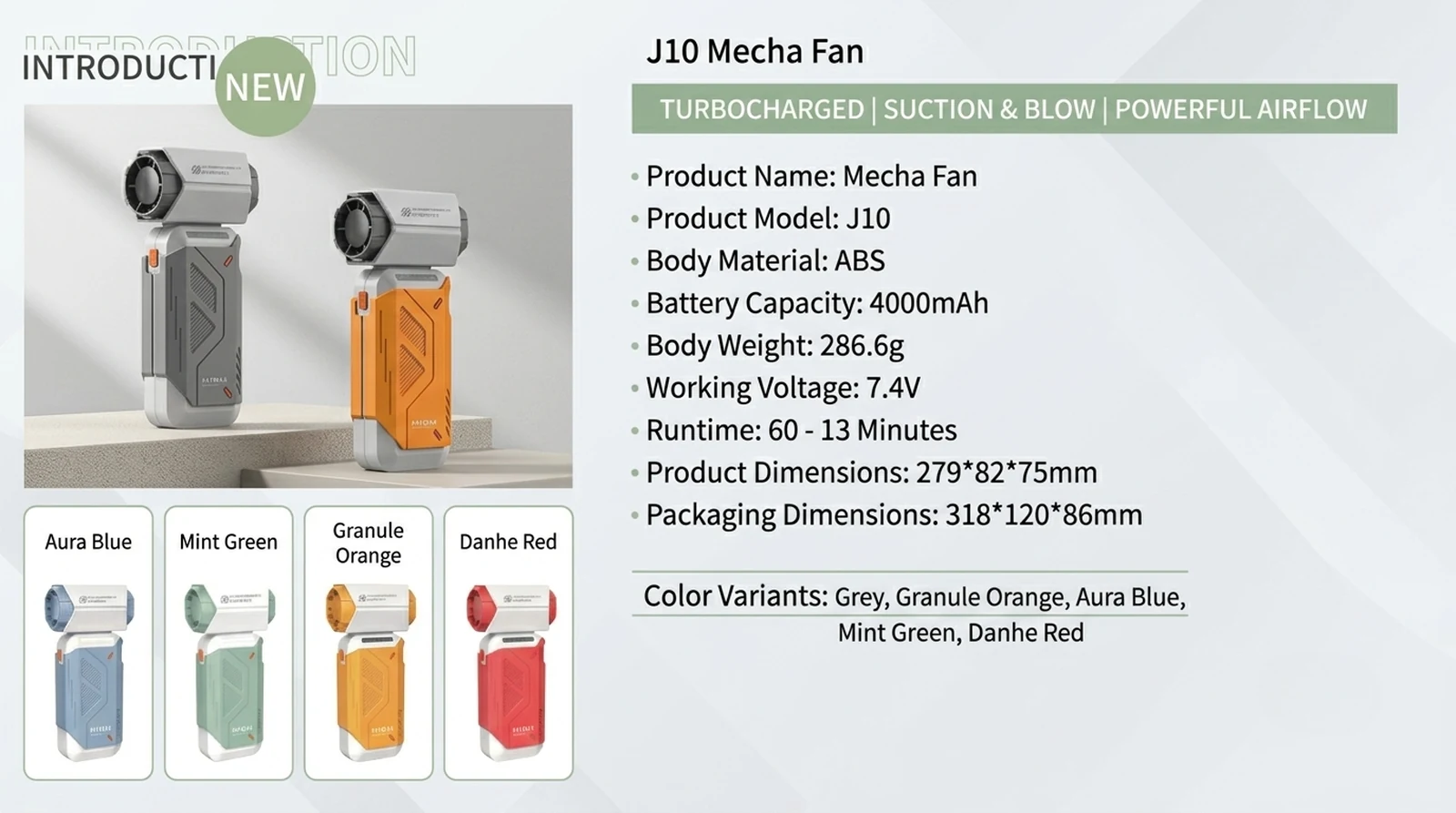
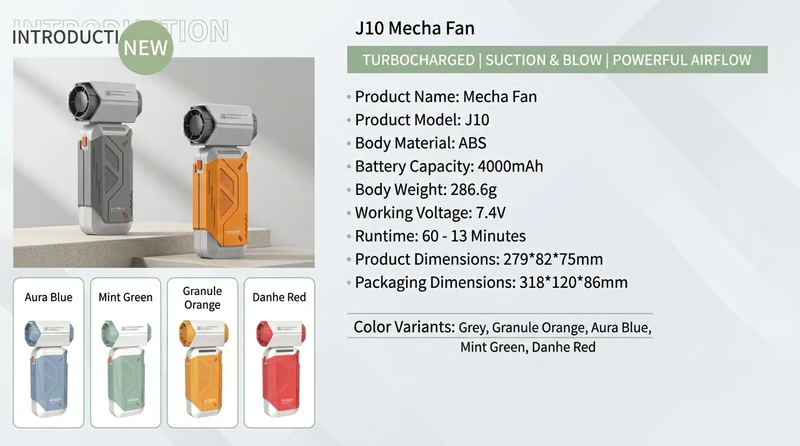
For teams looking for worked examples in the OEM portable-appliance space, the product catalog at [jlhy.cc/products/](https://jlhy.cc/products/) offers a useful reference set. Looking at how a portable fan spec is actually structured in production can help new buyers see the line between descriptive marketing copy and the engineering language a factory needs to plan tooling and compliance. As a concrete example of a structured spec sheet in production, the [J10 Mecha Fan](https://jlhy.cc/products/j10-mecha-fan/) demonstrates how performance, electrical, materials, and compliance sections are organized within a single product brief.

Frequently Asked Questions
**How detailed should a first-draft specification sheet be?**
Detailed enough that the factory's engineering team can mark it up without guessing. If they have to ask "what does this mean?" on more than a tenth of the lines, the first draft was too sparse. Iterate from there.
**Who owns the specification sheet inside the buyer organization?**
Typically the product manager or project lead, with named contributors from engineering, industrial design, compliance, and quality. One person must hold final authority for sign-off to prevent drift across revisions.
**Should suppliers be allowed to redline the buyer's spec?**
Yes. A good supplier will mark it up with feasibility observations, alternate material options, and clarified tolerances. The skill is disciplining those redlines into a documented change rather than an informal agreement.
**When should compliance testing begin?**
Right after the golden sample is approved, not at the bulk-production stage. Pre-compliance scans during engineering samples can flag issues while there is still time to change a component.
**Is the specification sheet a substitute for a contract?**
No. The spec defines what is being built; the purchase order and master supply agreement define the commercial terms, payment milestones, warranties, and remedies. The spec is an engineering appendix to those commercial documents.
Frequently Asked Questions
How detailed should a first-draft specification sheet be?
Detailed enough that the factory's engineering team can mark it up without guessing. If they have to ask 'what does this mean?' on more than a tenth of the lines, the first draft was too sparse. Iterate from there.
Who owns the specification sheet inside the buyer organization?
Typically the product manager or project lead, with named contributors from engineering, industrial design, compliance, and quality. One person must hold final authority for sign-off to prevent drift across revisions.
Is the specification sheet a substitute for a contract?
No. The spec defines what is being built; the purchase order and master supply agreement define the commercial terms, payment milestones, warranties, and remedies. The spec is an engineering appendix to those commercial documents.