Sample Evaluation Guide for Portable Fans and Personal Care Devices
A physical sample is the most honest document a buyer will ever receive from a supplier. This guide walks sourcing professionals through a structured sample evaluation process for portable fans and personal care devices, from first inspection to user-testing feedback.
Why Sample Evaluation Is the Most Critical Step in Sourcing

In the portable fan and personal care device category, the gap between a glossy catalog and a finished product can be enormous. Specifications on paper describe intent; a physical sample describes reality. For any B2B buyer, retailer, or private-label brand, the sample evaluation stage is where risk is either surfaced early or quietly inherited into a full production run.
Buyers who skip or rush this step tend to discover problems in three painful places: during incoming inspection, after the first retail returns, or — worst of all — in customer reviews. None of those are good classrooms to learn in. A disciplined sample evaluation process, by contrast, is a relatively low-cost form of insurance.
This guide is written for sourcing managers, category buyers, and operations leads who work with portable cooling fans, handheld misting devices, bladeless desktop units, neck fans, and adjacent personal care categories such as compact hair dryers or facial cleansing brushes. The principles are similar across these product families because the failure modes are similar: motor behavior, battery claims, material feel, finishing consistency, and packaging durability.
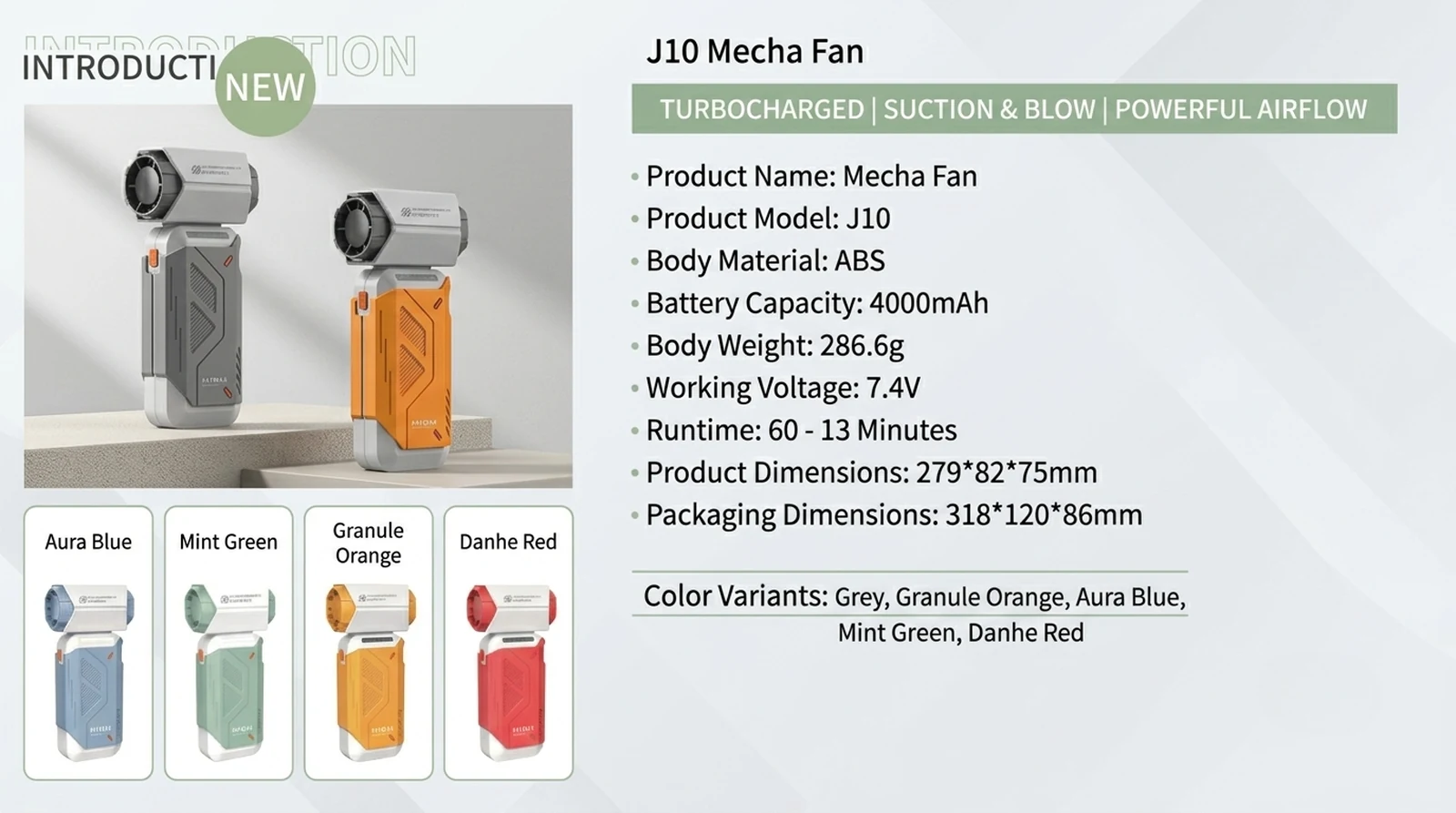
We will move from the rationale, through what to physically inspect, to packaging and labeling, then to user testing, and finally to how sample evaluation feeds downstream quality outcomes. Readers evaluating fan-style cooling products specifically may also want to compare notes with how reference models such as the [J10 Mecha Fan](https://jlhy.cc/products/j10-mecha-fan/) are positioned and documented, since mecha-styled portables have become a useful benchmark for chassis design and accessory bundling.
What to Inspect on the Physical Sample
Build Quality and Material Feel
Pick the unit up. The first ten seconds of handling tell you more than any spec sheet. Look for:
- **Consistency of plastic finish.** Run a fingertip along seams. Glossy surfaces should be uniform; matte surfaces should not have shiny patches that suggest incomplete mold polishing.
- **Creak and flex.** Apply gentle torsion to the body. A well-engineered shell resists flex and does not creak. Audible creaking usually points to insufficient ribbing or poor clip engagement.
- **Weight balance.** For handheld or neck-worn devices, balance matters more than total weight. A device that feels heavy at the front during a one-minute hold test will feel unbearable after ten.
- **Button and dial tactility.** Each control should have a clearly defined click, a consistent actuation force, and a positive reset.
For personal care devices, also check contact surfaces — comb teeth, brush bristles, blades, or nozzle edges — for burrs, sharp transitions, or rough molding lines. These are leading indicators of consumer complaints.
Motor, Fan, and Acoustic Performance
For portable fans, the motor and impeller assembly define the product. Listen before you measure:
- **Startup behavior.** Power on from a complete stop. A clean ramp-up suggests a healthy motor and controller; a shudder or grinding noise suggests bearing or alignment issues.
- **Speed range and step transitions.** Cycle through every speed setting. Listen for uneven steps, motor oscillation, or speed-step skipping that indicates a sloppy encoder or potentiometer.
- **High-speed stability.** Hold at maximum speed for five minutes. Watch for vibration creep, rattling internal components, or a noticeable pitch change as the motor warms up.
- **Acoustic profile.** A simple decibel reading at one meter is useful, but character matters too. A fan with a slightly higher dB but a smoother tonal profile is often preferred by consumers over a quieter fan with a whiny resonance.
For personal care devices with motors — hair dryers, cleansing brushes — substitute airflow or oscillation character for fan noise and apply the same logic.
Battery and Power System Claims
Battery run-time claims are the single most common source of dispute in this category. Treat every printed figure as a hypothesis to test, not a fact to record. Verify:
- **Rated capacity versus measured capacity.** A full charge, followed by a continuous run at a defined speed setting, should be logged in minutes. Repeat at minimum, medium, and maximum speeds.
- **Charging behavior.** Time from empty to full should be consistent with the supplier's stated figure. Indicator light behavior on the sample should match what the user manual describes.
- **Thermal behavior during charge.** Charge on a non-conductive surface and monitor for unusual warmth. Slight warmth is normal; hot-to-the-touch is not.
- **Connector quality.** USB-C, Micro-USB, or proprietary ports should seat firmly and resist wiggle. Loose connectors are a chronic return driver.
If the supplier quotes cycle life figures, those should be treated as supplier-supplied data points and corroborated against the cell manufacturer's published datasheet.
Finishing and Color Consistency
If you are sampling multiple units from the same batch, lay them side by side. Color drift between units — even within an accepted Pantone range — is the kind of defect that becomes visible only when a retailer photographs a shelf display.
For metallic finishes, anodizing consistency on edges and corners is a common weak point. For soft-touch coatings, test the surface with a cloth dampened with isopropyl alcohol; poor coatings will smear or lift, which is a strong predictor of in-store wear.
Packaging and Labeling Review During the Sample Stage
Packaging is often evaluated last, which is a mistake. By the time a buyer notices that the inner tray is too tight for the product, or that the gift box's window film scratches during shipping, the tooled packaging has already been paid for. Sample evaluation is the moment to catch these issues.
Structural Packaging Checks
- **Drop and vibration tolerance.** A pre-shipment drop test on a single retail unit is inexpensive. Look for box crush, internal shift, and accessory dislodgement.
- **Opening experience.** A good unboxing is rehearsed. If a child or a first-time user cannot open the package in under a minute without tools, the packaging has failed.
- **Insert fit.** Tray inserts should hold the device firmly without compressing buttons or scratching finishes. Foam inserts should not shed particles onto glossy surfaces.
- **Shipping configuration.** Master carton quantities and inner pack quantities should be confirmed against your warehouse receiving workflow.
Labeling and Regulatory Markings
Labeling is not a creative decision; it is a legal one. The sample is the right moment to lock down:
- Required regulatory marks for the destination market — for example, FCC and CE-related marks in their respective regions, with the supplier's responsible party information clearly identified.
- Battery handling symbols and UN38.3 transport references where applicable.
- Accurate electrical ratings, model number, and manufacturing date or batch code.
- Multilingual manual content for the markets you serve. The sample manual is your last easy chance to correct phrasing before tooling costs lock in artwork.
Translation and Documentation
It is common to discover at sample stage that the supplier's English manual is functional but awkward. Fixing phrasing on a sample is cheap; fixing it across an entire production run is not. Build a list of preferred terminology — for instance, "speed setting" versus "wind level" — and align it with the supplier during sample review.
User-Testing Feedback Collection
Sample evaluation is not complete when the sourcing manager signs off. It is complete when a small, structured panel of end users has used the device in realistic conditions.
Who Should Test
Pull from outside the sourcing team. Internal employees are biased toward approval, because they have already lived with the project. Aim for at least five to ten testers who match your target demographic. For portable fans, this often means commuters, office workers, outdoor users, and post-workout users. For personal care devices, it means users who already own the category and have informed preferences.
What to Capture
A simple structured form goes a long way. Categories to score:
- First-impression unboxing experience
- Comfort and ergonomics over a 15-minute session
- Perceived noise at each speed
- Real-world battery endurance against the supplier's stated figure
- Willingness to recommend to a friend
- Any unprompted comments about color, weight, or feel
Testers should be told that honest criticism is more useful than politeness. Capture verbatim quotes. They become marketing copy and product development notes in equal measure.
Comparing Iterations
The most useful sample evaluation programs involve two or three rounds. The first round establishes baseline performance. Each subsequent round should isolate one or two variables — for instance, a grip texture change or a new motor supplier — so that feedback can be cleanly attributed.

How Sample Evaluation Supports Quality Outcomes
A documented sample evaluation does more than approve or reject a single unit. It builds a reference artifact that the entire downstream organization can use.
A Shared Definition of Acceptable
When the sample review captures measured decibel readings, photographed finish samples, and signed-off labeling, it becomes the standard against which mass-production inspections are compared. Inspectors on the factory floor can hold the golden sample next to a randomly pulled production unit and judge conformance.
Reduced Rework and Returns
Most quality issues in portable fans and personal care devices originate from a small number of recurring causes: battery underperformance, switch failure, vibration, and finish inconsistency. Each of these is detectable at sample stage with a deliberate test plan. Eliminating them before tooling and packaging decisions are locked in is the single highest-leverage quality intervention available.
Better Forecasting and Pricing Conversations
Although specific unit pricing is never published in editorial content, it is worth noting that sample evaluation has a direct effect on landed cost. Decisions made at sample stage — battery cell choice, packaging material, accessory inclusion — cascade through every downstream cost layer. A buyer who evaluates samples carefully makes better-informed sourcing decisions and is in a stronger position when negotiating tiered commercial terms with the factory.
A Foundation for Continuous Improvement
A second or third sample round, with structured feedback between rounds, becomes a small but real R&D loop. Suppliers who engage with this loop honestly are the suppliers worth keeping.
Practical Tips for Running a Sample Program
- Always request at least three units per round, so that you can assess unit-to-unit variation rather than a single hand-picked example.
- Photograph every sample on receipt, with date and supplier batch code visible. The photo library becomes invaluable during disputes.
- Keep a sample retention policy. Store at least one approved unit per project for the full product lifecycle as a reference.
- Treat supplier-provided test reports as supporting evidence, not as a substitute for your own testing.
- Cross-reference the supplier's stated component sources — battery cell, motor, USB controller — against public datasheets where possible.
Where to Go From Here
A sample evaluation guide is only as useful as the discipline behind it. The portable fan and personal care category is crowded, and the differentiator between a forgettable product and a repeat-purchase favorite is rarely one large insight. It is dozens of small decisions, made carefully, at the sample stage.
If you are comparing mecha-styled portable fans specifically, take a careful look at how products such as the J10 Mecha Fan present their specifications, accessories, and user-facing documentation, and use that as a benchmark for the level of detail you should expect from any shortlist supplier. The bar is set by the strongest competitor, not by the average one.
Above all, treat the sample not as a formality but as the most honest conversation you will have with a supplier. Listen carefully, test deliberately, and document thoroughly.

Frequently Asked Questions
**How many sample units should a buyer request before placing a production order?**
Most structured programs request three to five units per round across two or three rounds. Three units allow basic unit-to-unit variation checks, while multiple rounds let you isolate specific changes such as motor or grip revisions.
**What is the most common defect discovered during portable fan sample evaluation?**
Battery run-time underperformance and inconsistent speed-step transitions are the two most frequent issues. Both are easily detected with a simple timed test and a quiet listening environment, yet both are routinely missed when buyers rely on supplier datasheets alone.
**Should sample-stage packaging tests include a real shipping simulation?**
Yes. A single drop test and a short vibration cycle on a representative master carton will reveal insert shift, accessory dislodgement, and window film scratching. These issues are nearly invisible in flat artwork but extremely visible when a retailer opens a damaged retail unit.
Frequently Asked Questions
How many sample units should a buyer request before placing a production order?
Most structured programs request three to five units per round across two or three rounds. Three units allow basic unit-to-unit variation checks, while multiple rounds let you isolate specific changes such as motor or grip revisions.
What is the most common defect discovered during portable fan sample evaluation?
Battery run-time underperformance and inconsistent speed-step transitions are the two most frequent issues. Both are easily detected with a simple timed test and a quiet listening environment, yet both are routinely missed when buyers rely on supplier datasheets alone.
Should sample-stage packaging tests include a real shipping simulation?
Yes. A single drop test and a short vibration cycle on a representative master carton will reveal insert shift, accessory dislodgement, and window film scratching. These issues are nearly invisible in flat artwork but extremely visible when a retailer opens a damaged retail unit.