How to Evaluate Turbocharged Portable Fan Samples in 2026 — B2B Guide
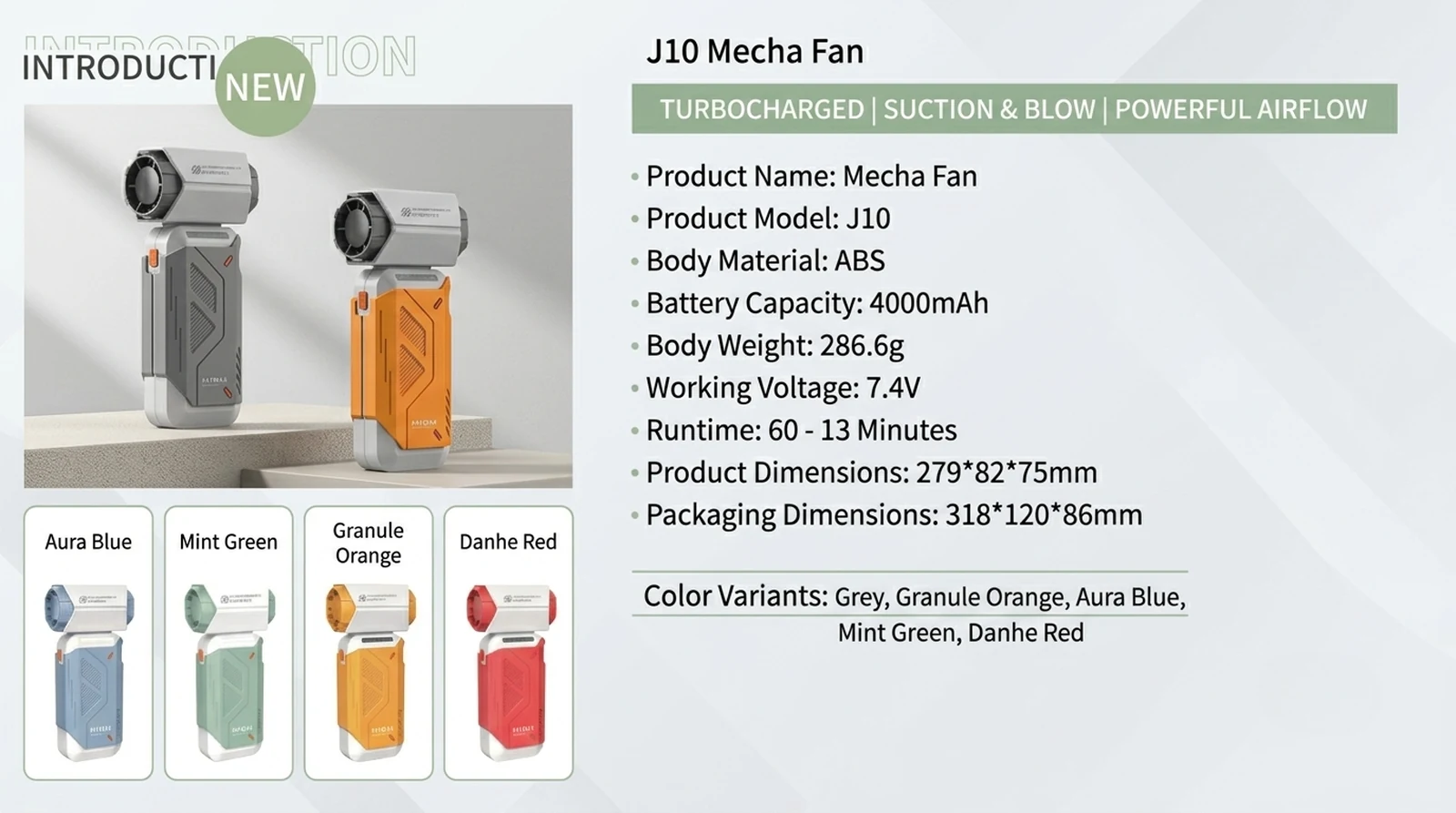

Importers evaluating turbocharged portable fan samples in 2026 face a more crowded field than at any point in the last decade. Performance claims are louder than ever, but verifiable testing data is harder to find. The right evaluation framework separates marketing copy from a sample worth scaling, and the difference shows up in warranty rates, retailer returns, and ultimately margin.
What "turbocharged" actually means in portable fans
The word "turbocharged" has slipped from automotive engineering into consumer electronics marketing with little agreement on what it actually delivers. In the portable fan category, it typically refers to a high-RPM brushless or brushed motor paired with an impeller geometry designed to move more air per watt than a baseline model. Some factories use the term for any fan above a certain RPM threshold; others reserve it for units that include a dedicated boost mode drawing extra current for short bursts of peak output. For importers, the practical question is not whether the label is fair, but whether the supplier can show measured airflow data behind it. Ask for CFM (cubic feet per minute) or cubic meters per minute figures captured with a calibrated anemometer at the fan outlet, not just the marketing copy. A sample worth your time will come with documentation, not adjectives.
The sample evaluation workflow importers should follow
A structured evaluation workflow keeps the process defensible when you bring findings back to your sourcing team or retail buyers. Most experienced importers follow a five-step pattern: request specification sheets, order physical samples, run lab and field tests, document defects and observations, and compare against two or three competing reference units. Each step should produce a written record — photos, video, measurement logs — that survives contact with shipping delays and time zones. Treat the first sample as a screening round, not a final judgment. Most reputable OEM/ODM factories expect two to three sample rounds before bulk production, and that expectation should be built into your timeline. A factory that promises perfect samples on the first try is either overstating capability or hand-selecting a sample that does not represent the production line.
Battery performance and runtime testing
Battery performance is where most turbocharged portable fan samples fall short of their printed specifications. A 4000mAh cell sounds impressive on paper, but actual runtime depends on discharge rate, motor load, ambient temperature, and whether the cell capacity is genuinely rated or rounded up. When a sample arrives, run it on maximum speed from a full charge and time the result. Compare against the factory's published runtime, then run the same test on minimum speed to map the full performance curve. For importers shipping to markets with strict consumer protection rules, runtime accuracy is a compliance issue, not just a quality issue. Look for samples accompanied by cycle test data — how the cell holds up after 300, 500, or 800 charge cycles — and verify whether the factory sources from a known cell maker or a generic white-label pack.
Motor noise and acoustic profile assessment
Noise is one of the most common reasons consumers return handheld fans, and importers who skip acoustic testing tend to pay for it later in warranty claims and negative reviews. A turbocharged motor running at peak boost will almost always be louder than a baseline model, but the practical question is how loud, and at what frequencies. A simple decibel meter reading at 30 cm and 1 m distances gives you a baseline. More useful is recording the sound profile — high-frequency whine versus low-frequency hum — because the latter is perceived as less annoying even at similar decibel readings. Run the fan across its full speed range, including the boost or turbo mode if present, and note the point at which the sound becomes uncomfortable. For European and North American markets, premium competitors set the bar; for emerging markets, regional expectations differ.
Build quality, materials, and durability
A portable fan that performs well on day one but cracks after three months is a liability, not an asset. When samples arrive, inspect the housing joints, button feedback, port covers, and any seam lines where moisture could enter. ABS plastic is the industry standard for handheld fans because it balances impact resistance, weight, and mold cost, but the grade of ABS varies significantly between suppliers. Tap the housing lightly — a hollow rattle suggests thin walls or insufficient ribbing inside. Weigh the unit against the spec sheet; a 30-gram discrepancy is a yellow flag worth investigating. Drop tests from one meter onto hard flooring, repeated three to five times, reveal a great deal about long-term durability. Importer checklists should treat this kind of stress testing as standard, not optional.
Dual-use functionality: suction and blowing modes
Dual-use fans that combine blowing and suction modes are a niche but growing category, particularly among outdoor, camping, and cleaning-focused buyers. The mechanism is straightforward — reversing motor direction or rerouting airflow through different nozzle geometries — but the execution varies widely. When evaluating samples, test both modes with the same rigor. A fan that blows strongly but sucks weakly is using dual-use as a marketing feature rather than a functional one. Measure airflow in each direction, and note whether the housing feels balanced or front-heavy when used in suction mode. Some designs require nozzle attachments that can be lost or broken; ask whether replacements are available and how the supply chain for spare parts is structured. For brands targeting cleaning applications, suction power at the nozzle tip matters more than peak motor RPM.
Airflow measurement and CFM benchmarking
Airflow is the number one specification importers compare, but it is also the easiest to inflate. Manufacturers report CFM figures under ideal lab conditions, often with the fan mounted in a test rig rather than held in a human hand. Build your own measurement protocol: a calibrated anemometer at fixed distances, multiple readings averaged, and a controlled ambient environment. Compare across three or more competitors, not just within one factory's product range. Relative performance is more useful than absolute numbers when deciding whether a sample is worth scaling. For OEM/ODM buyers, the deeper question is whether the factory's CFM claim is reproducible across production units, or only on the demo unit that won the order.
Compliance documentation importers must request
Sample evaluation is not complete without compliance paperwork. Before any sample leaves a Chinese factory, importers should request test reports relevant to their destination market — CE for Europe, FCC for North America, UKCA for the United Kingdom, RoHS for restricted substances, and REACH for chemical compliance. A factory cannot unilaterally hold these certifications, but a capable OEM partner can help coordinate testing through accredited labs. Ask which lab issued each report, whether it covers the exact model or a family variant, and when the report was issued. Reports older than two to three years may not reflect current production. CE and FCC marks without traceable documentation are increasingly a customs and marketplace risk, particularly for Amazon FBA and European retail channels.
Lead time, MOQ flexibility, and sample-to-bulk transition
A great sample that cannot be reproduced at scale is a research project, not a product. Before signing off, confirm MOQ flexibility, sample-to-bulk lead time, and the factory's monthly capacity. For new importers, MOQ 500 is a common starting point; MOQ 1000 unlocks better material pricing and customization options. Lead time from sample approval to first bulk shipment typically runs 30 to 45 days for handheld fans, longer if custom molds, color matching, or branded packaging are involved. Ask for a written production schedule with milestones, not just a verbal reassurance. Factories serving 30+ countries with 150,000+ units monthly capacity have usually built repeatable processes; smaller workshops may offer lower MOQs but with greater schedule risk.
Red flags in sample evaluation
A few patterns consistently signal trouble during sample evaluation. The first is reluctance to provide test data — a factory that cannot produce battery cycle reports, CFM measurements, or acoustic profiles is asking you to take their word for it. The second is sample-to-sample inconsistency: if the second sample differs noticeably from the first in weight, finish, or performance, the production line is not yet stable. The third is pricing that seems too efficient given the specification; in handheld fans, BOM cost has floors that aggressive quotes tend to ignore. Finally, watch for factories that resist third-party inspection or refuse to share factory audit reports. Trust is built through transparency, and sample evaluation is the earliest window you have to test that.
Related Articles
For deeper coverage of adjacent sourcing topics, see our [guide on portable fan battery sourcing](/articles/portable-fan-battery-sourcing-guide/) and our [checklist on vetting Chinese OEM factories](/articles/vetting-chinese-oem-factories-checklist/). Both pieces extend the sample evaluation process into cell selection and supplier due diligence.
As portable fan competition intensifies through 2026, importers who build structured, documented sample evaluation processes will outpace those who rely on factory sales pitches alone.
Frequently Asked Questions
What does "turbocharged" actually mean in portable fans?
In the portable fan category, the term typically refers to a high-RPM motor paired with an impeller designed to move more air per watt than baseline models, often paired with a boost mode for short bursts of peak output. There is no industry-standard definition, so importers should request measured airflow data behind any turbocharged claim.
How long should the sample evaluation process take?
Most experienced importers allow two to three sample rounds over three to six weeks, covering specification review, physical testing, comparison against reference units, and supplier feedback loops. Rushing the process increases the risk of surface-level defects reaching retail.
What compliance documents should importers request with samples?
At minimum, request CE for Europe, FCC for North America, UKCA for the United Kingdom, RoHS for restricted substances, and REACH for chemical compliance. Verify which accredited lab issued each report, the report date, and whether it covers the exact model or a family variant.