Why Women's Personal Care Brands Are Adding Heating Belts to Their Lineup

The women's personal care category has quietly expanded over the past five years from a niche aisle of supplements and skincare into a sprawling ecosystem of femtech wearables, cycle-care devices, and wellness hardware. Forward-leaning brands that once treated menstruation as a quiet footnote now position cramp relief, sleep support, and recovery as core parts of their identity. At the center of this shift sits a deceptively simple device: the menstrual heating belt. For B2B importers evaluating where to extend their catalog, this category offers a rare mix of consumer demand, manageable hardware complexity, and clean cross-sell mechanics — but only when sourced and positioned correctly.
The Shifting Landscape of Women's Wellness Categories
The women's wellness shelf has changed dramatically in the past five years. What once lived in a narrow feminine hygiene aisle is now a sprawling category spanning wearables, supplements, period care, and tech-forward comfort devices. Forward-leaning brands are no longer treating menstruation as a topic to handle quietly — they are repositioning cramp relief, sleep support, and recovery as part of a holistic lifestyle.
A menstrual heating belt sits at the intersection of wearable tech and self-care, which makes it a natural adjacency for any skincare, body care, or intimate wellness brand looking to extend its line. The category has also moved from pharmacy-only distribution into DTC subscription boxes, beauty retailers, and even boutique fitness studios, opening more doors for emerging brands than the legacy pain-relief patch ever could.
Anatomy of a Modern Menstrual Heating Belt
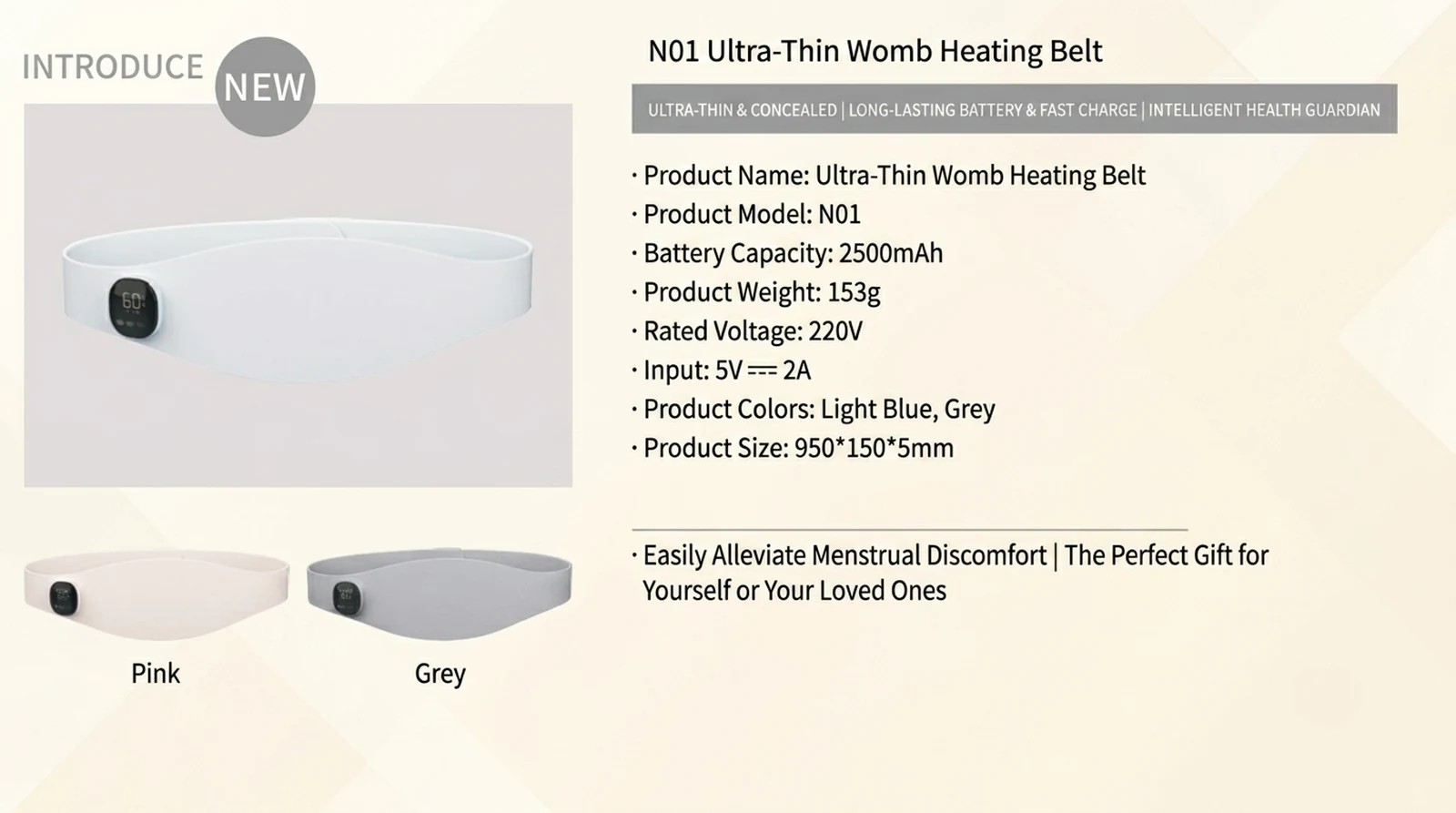
The new generation of heating belts is not the bulky electric blanket wrap of a decade ago. The current design benchmark is thin enough to hide under clothing, light enough to forget wearing, and quiet enough for an office setting. The N01 ultra-thin menstrual heating belt, for instance, weighs 153g and measures 950 by 150 by 5 millimeters, slipping into a waistband without bulk. Its 2500mAh battery delivers hours of steady warmth without the hot-spot pulses common in older pads.
Most brands launching in this category now expect at minimum a skin-safe outer fabric, USB-C charging, three or more heat settings, and an automatic shut-off. These specs are no longer differentiators; they are the table stakes. The real product story is in how the belt feels against the body, how discreetly it disappears under a fitted shirt, and whether it holds up to repeated machine washes. For B2B buyers, that means evaluating not only the BOM but the supplier's QC track record on heat uniformity and seam integrity across hundreds of units.
Why the Heating Belt Fits the OEM/ODM Playbook
For brands used to sourcing lotions, oils, or supplements, adding a hardware SKU can feel intimidating. The heating belt is one of the friendlier hardware categories to enter because the form factor is standardized, the BOM is well understood, and most Chinese OEM/ODM factories already have the tooling. A buyer can move from concept sketch to production samples in a typical tooling-and-sample cycle that mirrors other small electronics like handheld fans or scalp massagers.
The category also benefits from very strong crossover with existing wellness customer segments — a buyer of magnesium glycinate or a heated eye mask is exactly the buyer a heating belt targets. This makes marketing reinvestment efficient: email lists, retail buyers, and influencer partnerships built around cramps and cycle care transfer with minimal reframing. It is rare to find a hardware category with such a clear reuse of existing brand assets, which is why so many emerging DTC labels are quietly adding one to their 2025–2026 lineup.
Material, Battery, and Skin-Safe Compliance Considerations
Because the device sits directly on bare skin for long durations, fabric certification and battery safety are non-negotiable. Most importers in this category specify a low-irritation outer layer — often a Lyocell-cotton blend or medical-grade silicone edging — and require an OEKO-TEX or equivalent skin-contact test report. Battery sourcing is the bigger headache.
Lithium-polymer cells must comply with UN38.3 for air freight, and most retail buyers in Europe and North America expect CE, FCC, UKCA, RoHS, and REACH documentation as a baseline. A reliable OEM/ODM partner will help obtain these certifications rather than leaving the importer to chase paperwork, but the importer still owns the regulatory sign-off in the destination market. Plan to budget several months for first-time certification if your brand has not previously registered a battery-driven consumer device. For brands already selling other 5V-USB devices, the documentation stack usually overlaps, which shortens the path significantly.
Differentiation Through Customization, Color, and Brand Touch
Heating belts look similar on the outside, so differentiation is mostly visual and tactile. Colorways are the cheapest lever — most factories offer three to five stock shades and can dye to Pantone within typical MOQ thresholds. Beyond color, brands are exploring jacquard-woven logos, embossed silicone edge strips, and custom woven care labels that read as quietly premium in the hand.
Some forward-thinking brands are also adding companion apps that let users track cycle phase alongside heat sessions, though this introduces Bluetooth module sourcing and app-development overhead that not every OEM has in-house. For most newcomers to the category, a tighter, more focused launch — one signature color, one heat profile tuned to a specific customer persona — outperforms a five-SKU debut. The custom tooling premium for an exclusive shell color or a unique heat curve is small compared to the marketing efficiency of owning a clear niche inside a still-crowding category.
Channel Strategy: D2C, Retail, and Subscription Bundles
Where the heating belt lands in a brand's channel mix shapes every upstream decision. A pure-D2C launch leans on bundle math: pair the belt with a soothing tea, a topical balm, or a sleep supplement to lift average order value and improve first-purchase retention. Specialty retailers like boutique pharmacies, mom-and-baby stores, and curated wellness chains tend to prefer individual SKUs in retail-ready packaging with bar codes already on the box.
Marketplace channels — Amazon, Tmall Global, and the regional equivalents — have stricter battery-shipping labeling rules, and a few categories of heating belt have already faced customs queries in Europe around lithium-cell declarations. Subscription box placement is the underrated channel here, because a single cycle-care box can move thousands of units in a quarter and seed long-tail DTC sales. Most successful brands enter with two channels, learn the operational quirks, then expand — see our broader sourcing playbook for women's wellness brands for sequencing guidance.
Sourcing Logistics: MOQ, Lead Time, and Capacity Planning
The operational backbone of a heating belt launch is the factory relationship. At OEM/ODM shops in Dongguan, Guangdong, the standard MOQ is typically 500 units for a stock configuration and 1000 units when exclusive color or branding is requested. Lead time from confirmed PO to bulk shipment is usually measured in weeks for repeat orders, with longer windows for first builds that include sample iterations and tooling sign-off.
Production capacity at a mid-sized facility generally sits in the 150,000+ units per month range across the full personal-care appliance line, which means even a multi-SKU launch will not strain the line. For importers planning a seasonal push — Q4 gift-giving or a January new-year routine campaign — back the dates up by at least one full production cycle plus ocean transit. Air freight is possible for urgent restocks, but lithium cells carry surcharges and require specific documentation that not every forwarder handles routinely.
Packaging, Kitting, and Unboxing as Brand Storytelling
Heating belts are an unusually good category for elevating the unboxing moment. The device is slim, flat, and giftable, which means the box can lean into a book-like or jewelry-box opening rather than the clamshell blister packs typical of older pain-relief devices. Eco-conscious brands in this space increasingly request FSC-certified paperboard, soy-based inks, and molded pulp inserts in place of expanded foam.
A printed fabric pouch or a small laundry bag doubles as both a storage solution and a quiet branding cue — customers will reuse it, and every reuse is a brand impression. Kitting options are also popular: pairing the belt with a heat-safe herbal sachet, a calming tea sample, or a cycle-tracking journal turns a single-device order into a cohesive self-care story. For B2B buyers evaluating factories, ask to see full kitted samples, not just the bare device, because packaging defects are a far more common return reason than device failure in this category.
Common Pitfalls When Adding a Heating Belt to the Catalog
The pattern we see most often: a brand is excited by the category, places a 500-unit order, and underestimates three things. First, battery shipping documentation. Lithium cells require correct UN38.3 test summaries, MSDS sheets, and dangerous goods declarations or shipments get held at customs. Second, sizing realism. A one-size-fits-most belt can fit poorly on a wide range of bodies, and returns in this category cluster heavily around fit rather than function.
Third, customer support staffing. Unlike a passive skincare product, a heating belt has multiple heat settings, a charging port, wash instructions, and battery-care expectations — the support volume per unit is meaningfully higher. Build the FAQ, the troubleshooting video, and the battery-care insert before the first shipment lands at the warehouse, not after. For more on these operational patterns, our B2B personal care sourcing guide walks through how importers at similar scale have avoided each trap.
Building a 12-Month Launch Roadmap for the Category
A clean twelve-month rollout for a heating belt usually starts with supplier selection and sample evaluation in months one and two, tooling sign-off and pre-order forecasting in months three and four, first production and certification in months five and six, and a soft launch to the existing customer base in month seven. Months eight through ten expand into marketplace and retail, and months eleven and twelve focus on bundle iterations, color extensions, and gift-channel positioning for the next calendar year.
Brands that follow this cadence consistently outperform those that try to compress everything into a single quarter, because every stage reveals issues — fabric sourcing, battery consistency, packaging damage rates — that benefit from real-time adjustment. As the category matures, expect to see more brands treat the heating belt not as a standalone product but as a recurring anchor in a broader cycle-care ecosystem that builds durable customer relationships well beyond the first device sold.
Frequently Asked Questions
What MOQ should a new brand expect for a menstrual heating belt?
Most OEM/ODM factories in Dongguan start at 500 units for a stock configuration and 1000 units for exclusive colorways or branding. Custom tooling or packaging may require higher minimums depending on complexity.
How long does it take to bring a heating belt from concept to first shipment?
A typical timeline runs three to four months for first production after supplier selection, including sample iteration, tooling sign-off, certification, and ocean transit. Repeat orders after that can move significantly faster.
Which certifications are usually required for selling a heating belt in Europe or North America?
CE, FCC, UKCA, RoHS, and REACH are the standard baseline, plus UN38.3 documentation for the lithium-polymer battery to clear air freight and customs. A qualified OEM partner will help obtain these rather than leaving the importer to manage them alone.