Battery Safety Certifications for Heating Belts: Importer's Compliance Checklist

Wearable heating belts sit in one of the most safety-sensitive corners of the consumer electronics market: a lithium-ion cell strapped to a human body, often worn for hours under clothing. For importers sourcing these devices from Chinese OEM/ODM factories, the question is not whether a heating belt "works" in a sample run, but whether the battery system inside it has been independently tested against the standards that customs brokers, retailers, and insurance carriers all expect to see. This guide walks through the certifications B2B buyers should require, what each one actually proves, and how to verify the paperwork is real before the first container leaves the port.
Why Battery Certifications Matter in Wearable Heating Devices
Lithium-ion cells in compact wearables carry a unique risk profile. They are small enough to be worn directly against the skin, they are recharged frequently, and they operate in a sealed enclosure where thermal runaway can be invisible until it is too late. When a heating belt runs a 2500 mAh cell at low current over a 30–60 minute session, the energy density per square centimeter is higher than in many phone batteries.
Importers are the parties customs authorities, retailers, and product liability insurers hold responsible when something goes wrong. A heating belt without recognized battery certifications is effectively uninsurable in major retail channels, and Amazon, Target, and large European chains all routinely request paperwork before listing. The cost of a recall, a customs seizure, or a product liability lawsuit dwarfs the cost of demanding the right test reports during sourcing.
Beyond liability, certifications function as a quality signal. A factory that has put its packs through UN 38.3 transport testing and IEC 62133 cell-level evaluation has, by definition, submitted its design to third-party laboratories. That is meaningfully different from a factory that issues only an internal QC sheet.
UN 38.3 — The Baseline Transport Test
UN 38.3 is the United Nations transport test standard for lithium batteries, and almost every shipping line, freight forwarder, and customs authority requires it before a lithium product can move by air, sea, or land. The test subjects the cells and packs to eight procedures: altitude simulation, thermal test, vibration, shock, external short circuit, impact, overcharge, and forced discharge.
For importers, the practical question is whether the certificate covers the finished pack configuration, not just the bare cell. A pack built around a 2500 mAh cell with a BMS and heating element will behave differently under shock and thermal stress than a bare 18650. Insist on a UN 38.3 test report that names the final pack assembly, ideally with photographs of the unit that was tested.
UN 38.3 must be renewed when the cell chemistry, capacity, or pack topology changes. A certificate from several years ago for a different product is not valid for a current heating belt design. Ask for a report dated within the last 24 months and confirm the test lab is on the IECEE list of approved facilities.
IEC 62133 — The Cell-Level Safety Standard
IEC 62133 is the international standard for portable secondary cells, and it is the single most cited battery safety reference in CE-marked products. It covers nickel-system and lithium-system cells, with detailed procedures for continuous low-rate charging, vibration, thermal abuse, crushing, and external short circuit at the cell level.
A heating belt destined for Europe, Japan, Korea, or most of Asia will be expected to carry an IEC 62133 test report from an accredited lab such as TÜV Rheinland, TÜV SÜD, Intertek, SGS, or CTI. The report should reference the specific cell model used in the heating belt.
Be cautious when suppliers offer a "CE certificate" without naming the underlying standards. CE marking is only meaningful when supported by the harmonized standards that make up the technical file. IEC 62133 is one of the foundation stones of that file for any product with a rechargeable lithium cell.
UL 2054 and UL 1642 — North American Cell and Pack Standards
For products bound for the United States and Canada, UL standards carry significant weight. UL 1642 covers lithium cells, while UL 2054 covers household and commercial batteries. Neither is mandated by federal law for consumer heating belts, but retailers, Amazon, and insurance carriers routinely require UL-listed or UL-recognized components.
There is a frequent confusion in the market: a "UL listed" mark on a finished heating belt does not exist as a category in the same way it does for a phone charger. What importers should look for is UL 1642 recognition for the cell and UL 2054 evaluation for the pack, ideally with a UL file number that can be looked up in the UL Product iQ database. A genuine UL file can be verified online in seconds; a missing or unverifiable file number is a red flag.
ETL and CSA marks from Intertek and CSA Group are widely accepted equivalents in the North American market and can be easier to obtain for smaller production runs. The key is third-party verification, not the specific logo.
CE, RED, EMC, and LVD — The European Compliance Stack
In Europe, a heating belt with Bluetooth or any wireless control falls under the Radio Equipment Directive (RED 2014/53/EU), while the heating element itself is governed by the Low Voltage Directive (LVD 2014/35/EU) and EMC Directive (2014/30/EU). Battery safety is addressed through the harmonized standards EN 62133 and EN IEC 62368-1.
A responsible OEM partner will help obtain CE, UKCA (for Great Britain post-Brexit), FCC (for the US), RoHS, and REACH documentation. They will not claim to "hold" the certificates themselves — those are issued to the importer or brand owner as the legal manufacturer placing the product on the market. What the factory should provide is the test reports and technical construction file that you, as the importer, sign off on.
RoHS restricts hazardous substances in the electronics, while REACH governs chemical substances across the product. Both are mandatory for the European market and have become standard requirements in many other regions. Requesting both upfront is normal practice for serious B2B sourcing.
MSDS, UN 3480/UN 3481, and Shipping Classification
Beyond product safety, importers need documents that allow the goods to actually move. The Material Safety Data Sheet (MSDS) for lithium cells describes the chemistry, hazard profile, and handling instructions. The UN number classification — UN 3480 for lithium cells alone, UN 3481 for cells packed with or contained in equipment — determines how the shipment is packaged, labeled, and routed.
Air freight on passenger aircraft is restricted by watt-hour limits; most heating belt packs fall well under that limit, but the documentation must still be in place. Sea freight is more permissive but requires the same paperwork. A factory that cannot provide a current MSDS and a clear UN classification is signaling that they have not thought through the logistics side, which is often a proxy for other compliance gaps.
How Importers Can Verify Certification Authenticity
Paperwork fraud is more common than most importers realize. Common tells include: certificates that are not issued to the actual factory, test reports with no laboratory accreditation number, certificates listing standards that have been superseded, and documents with altered dates. Always cross-check the issuing lab against the accreditation body's directory — CNAS in China, A2LA in the US, DAkkS in Germany, UKAS in the UK.
For UL files, search the UL Product iQ database by company name or file number. For CE documents, request the EU Declaration of Conformity and verify that the harmonized standards listed are current. For UN 38.3, confirm the test lab is on the IATA-recognized list. A 30-minute verification step can save a six-figure recall.
Documentation an OEM Should Provide Pre-Shipment
A factory with mature compliance processes will package the following into a pre-shipment file: UN 38.3 test report, IEC 62133 or EN 62133 report, MSDS, cell specification sheet, BMS schematic, pack assembly drawing, RoHS test report, REACH declaration, and the user manual with safety instructions. For North American-bound products, add UL 1642/2054 or ETL equivalent.
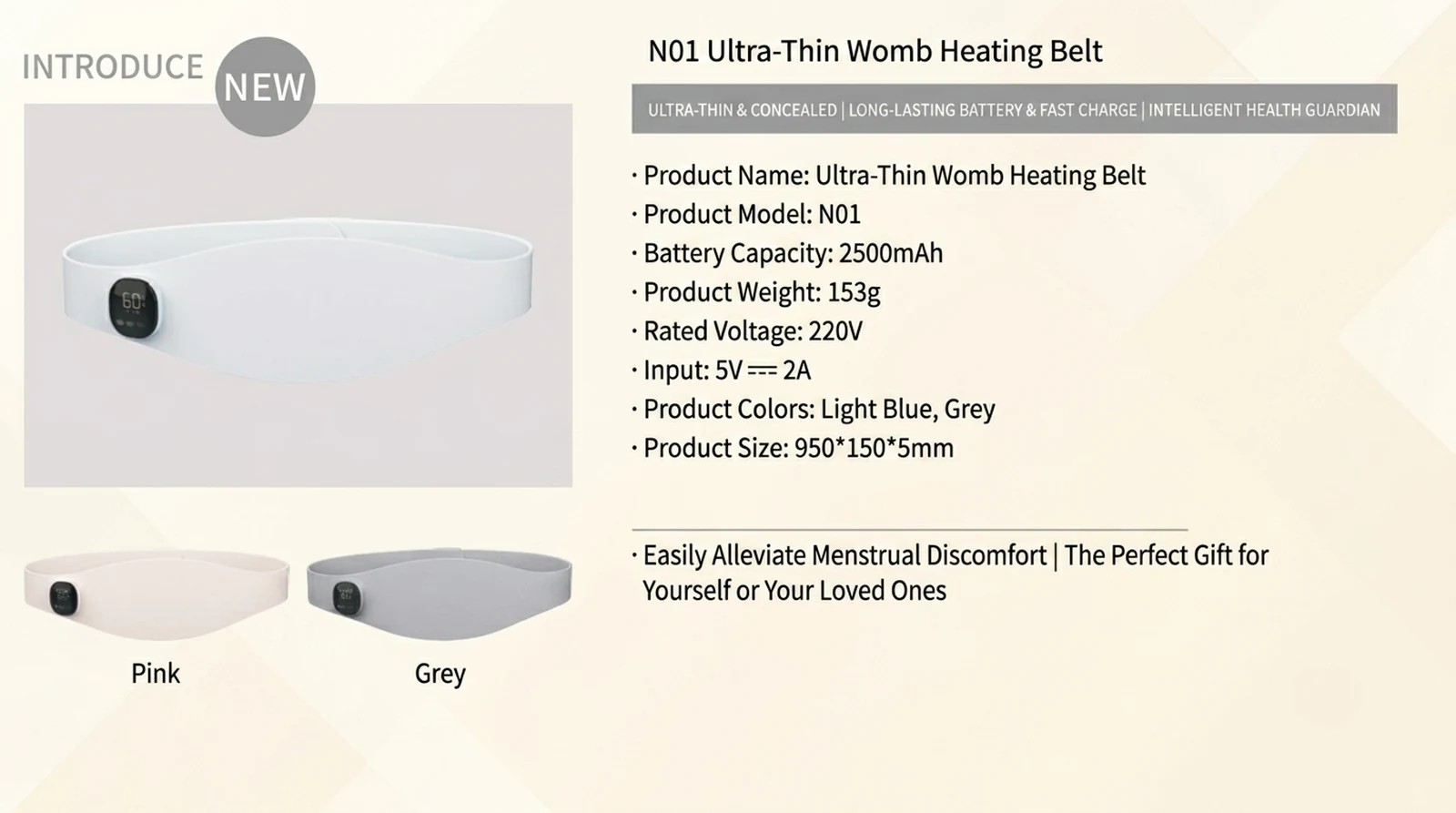
The N01 ultra-thin menstrual heating belt, for example, is built around a 2500 mAh lithium-polymer cell in a 5 mm-thick ABS-encased waistband. The supporting paperwork for a product like this should be matched to that exact cell and pack configuration, not lifted from a sibling SKU with a different capacity. See our OEM supplier documentation checklist for the complete version-controlled file structure we recommend to B2B buyers.
Building a Long-Term Compliance Workflow
Certification work is not a one-off event. Every time the cell supplier changes, the BMS firmware updates, or the pack capacity moves by more than 10%, the test reports need to be re-evaluated. Treat compliance as a version-controlled discipline, not a folder of PDFs that gets emailed back and forth.
Build a relationship with a third-party lab in your target market — TÜV, SGS, Intertek, Bureau Veritas — and have them perform periodic witness testing. From the factory side, we maintain 150,000+ units/month capacity with a 4-stage QC process and can help obtain CE, FCC, UKCA, RoHS, and REACH documentation across the product family, but the legal responsibility for placing the product on the market remains with the importer. Clear ownership prevents confusion when an auditor or customs officer asks questions.
What to Do When a Supplier Cannot Provide Paperwork
If a factory is reluctant, slow, or vague about certification documents, treat that as a sourcing decision in itself. The most common reasons for evasiveness are: the cells are sourced from an untraceable trader, the pack was assembled without BMS documentation, or the factory is reselling a competitor's product under a private label. None of these are dealbreakers on their own, but each requires specific remediation before shipment.
Set a hard cut-off in your sourcing timeline: full battery documentation must be in your inbox before production payment milestones, not at the shipping mark. This one procedural rule eliminates the majority of post-production compliance disputes in the heating belt category, and it scales as your SKU count grows across multiple regions and retailers.
Related Articles
For a broader view of wearable heating product sourcing, see our guide on wearable heating device OEM workflows. For a closer look at how the same battery compliance stack applies to handheld fan products from the same factory, see the J10 Mecha Fan certification overview on the sister site. To explore the N01 specification sheet and configurator, visit the N01 product page on the main brand site.
Frequently Asked Questions
What is the single most important battery certification for a heating belt?
For air-shippable lithium packs, UN 38.3 is non-negotiable — without it, most freight carriers will refuse the shipment. For European market access, EN 62133 (the European adoption of IEC 62133) is the cell-level safety standard that anchors the technical file behind your CE Declaration of Conformity.
Can a Chinese factory issue a CE certificate directly to me?
No. CE marking is a declaration by the entity placing the product on the EU market, which is typically the importer or brand owner. A factory can only provide the test reports and technical construction file that supports your Declaration of Conformity — the importer signs it.
How long are battery test reports considered valid?
There is no fixed expiration, but most importers and retailers treat reports older than 24 months as needing re-evaluation, especially if the cell model, capacity, or pack assembly has changed. UN 38.3 in particular must be re-issued when the cell chemistry or pack design changes materially.